
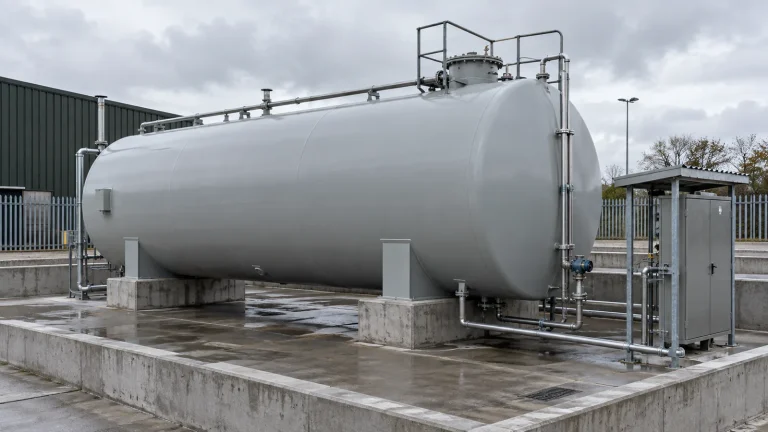
A diesel storage tank can show a normal inventory level while a separate water layer sits below the fuel outlet. The next delivery or transfer may disturb that layer, changing what reaches filters and downstream equipment. For an industrial site, this is a storage-integrity and operating-reliability problem, not simply a housekeeping detail.
This guide focuses on water bottoms in aboveground diesel storage tanks, including tanks serving industrial utilities and standby power systems. It covers monitoring and engineering interfaces rather than a full tank-cleaning procedure. The principles do not automatically transfer to gasoline, aviation fuel, alcohol-containing products or chemical tanks, which require their own product-specific controls.
Water Content and Water Bottoms Are Different Questions
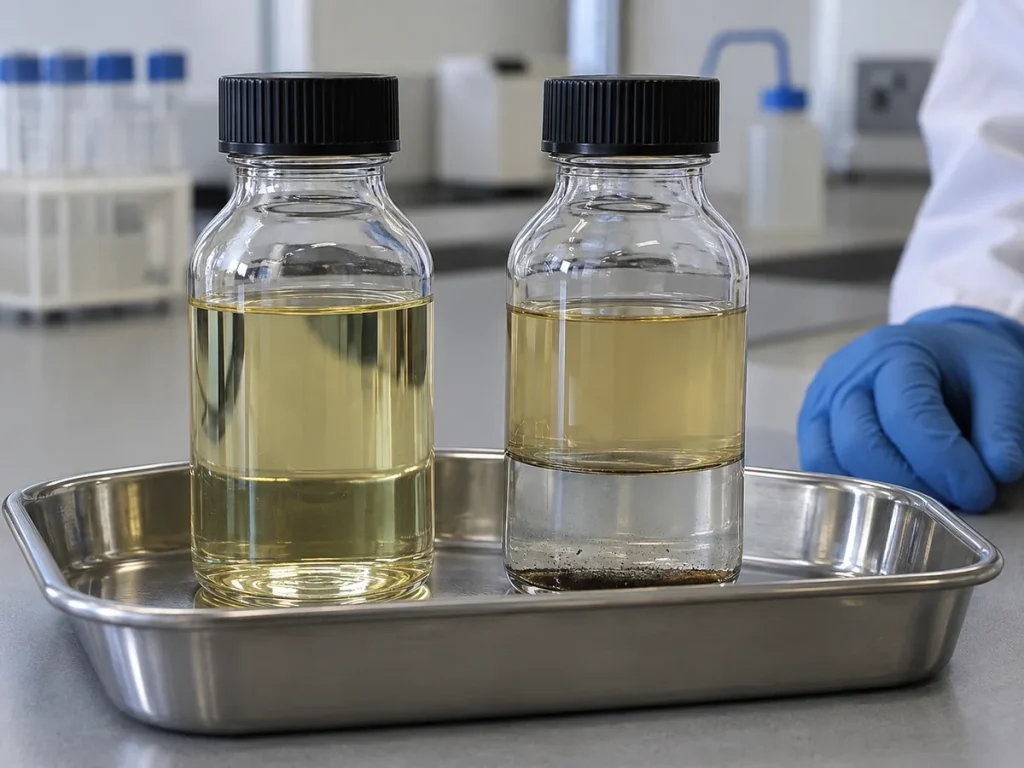
Water can be dissolved in fuel, dispersed as droplets, or present as a separate free-water phase. Dissolved water may not be visible. Dispersed droplets can cause haze, although haze alone does not identify the contaminant. Free water can collect at low points after separation because it is denser than diesel. Fuel composition, temperature and the degree of agitation affect what a sample looks like.
Consequently, “no visible water” is not the same as a laboratory water-content result, and a low water-content result from the upper fuel layer does not describe a bottom pocket that was never sampled. Treat bulk-fuel quality and bottom-water accumulation as two related measurement tasks. Neither should be inferred solely from the main product-level indication.
Find the Entry Route Before Assuming Condensation
Possible sources include delivered fuel, rain entering defective closures or connections, moisture associated with air exchange, and residual water left after maintenance. The US Department of Energy’s fuel-management report discusses water entry and the role of water in fuel deterioration. Its biodiesel context matters: blend composition can change handling requirements, so do not apply one fuel’s assumptions to every stored product.
Build a site-specific event history instead of labeling every recurrence “condensation.” Did the observation follow a delivery, a storm, a shutdown or a repair? Was water already present beforehand? Were tank closures disturbed? Did another tank receiving the same batch show a similar change? These questions help decide which records and physical interfaces to investigate without claiming that timing alone proves a cause.
For example, an increase after rain warrants a closer look at weather-exposed connections, but rainfall and fuel receipt may have occurred on the same day. Retain both events in the investigation. Repeatedly removing water without resolving its entry route can conceal an ongoing defect.
Use the Actual Tank Geometry
A convenient sampling connection is not necessarily at the lowest point. In a horizontal tank, the installed orientation and local bottom geometry affect where water collects. In a large vertical tank, floor profile, sumps and local depressions can produce more than one collection area. Drawings are a starting point; inspection and as-built information determine whether the intended collection route exists in the installed tank.
Ask the designer or maintainer to identify the sample pickup elevation, water-removal pickup, product suction elevation and relevant instrument reference. A product outlet deliberately located above the floor can reduce direct pickup of settled material, but it does not remove the material underneath it. Raising a suction point also changes usable inventory and needs engineering review rather than an improvised field alteration.
A water-depth reading is not automatically a reliable volume. Cross-section, slope and the reference location matter, especially near the bottom of a horizontal cylindrical tank. Keep any quantity estimate consistent with the approved tank calibration and capacity-table basis, and record uncertainty rather than presenting an assumed flat-layer calculation as a measured quantity.
Design the Monitoring Plan Around the Question
Different observations serve different purposes. An interface-capable sensor or suitable water-detection method can indicate free water at its measurement location. A bottom sample can reveal a locally separated phase or settled material. A representative fuel sample sent to a laboratory can answer a specified quality question. None should be described as a complete substitute for the others.
The Transportation Energy Institute’s diesel storage practices guide discusses monitoring around deliveries and cautions that in-tank systems may not detect every water level. Select water-indicating products compatible with the actual fuel blend and follow their instructions. Do not turn a generic schedule into a universal rule: establish routine and event-triggered checks using site history, turnover, consequences and applicable requirements.
Before commissioning a sample, write down the question it must answer. “Is there free water at this pickup?” differs from “Does the fuel intended for use meet its specification?” Specify the location, depth or pickup, tank operating condition, time since a relevant disturbance, and sample handling. Use a qualified service provider and the site’s approved sampling arrangements; this article is not permission to open a hatch or improvise a sampling device.
For laboratory work, agree the method and interpretation with the laboratory. ASTM D6304 describes coulometric Karl Fischer determination of water in petroleum products and related materials. A result describes the submitted sample under the applicable method; it does not establish that the entire tank bottom is dry. Confirm the applicable method edition, fuel specification and reporting units instead of inventing one universal ppm acceptance limit.
Respond to Findings Without Creating a Release
When a monitoring result changes, first confirm what was measured and whether the method and location were appropriate. Escalate suspected contamination or compromised tank integrity through the operating procedure. The authorized site team should decide whether fuel can continue to be transferred, needs segregation or requires additional testing. A clear-looking follow-up sample is not, by itself, release authorization.
Water draw-off is a fuel-handling activity: the stream may contain diesel, sediment and other contaminants, and its composition can change during removal. Define the responsible operator, approved collection equipment, containment, monitoring, stopping criteria and waste route before starting. Do not discharge it to the ground, stormwater system or an ordinary drain simply because it appears mostly water. Waste classification and disposal depend on the actual material and local requirements.
Keep tank-water removal separate from rainwater management inside the surrounding bund. The two streams have different origins, and connecting them casually creates a release pathway. Review this interface with the site’s secondary containment and drainage arrangements. A removal record should identify both the quantity collected and the destination, not just say “tank drained.”
Do Not Diagnose Microbial Contamination by Appearance
Water can support microbial activity in fuel systems, and contamination may contribute to deposits, filter problems and corrosion. However, dark material is not proof of living microbes, and corrosion can involve multiple mechanisms. ASTM D6469 provides background on the occurrence, detection and control of microbial contamination. Use appropriate sampling and specialist interpretation before selecting a treatment.
The EPA’s diesel-tank corrosion research concerns underground storage tanks. It is useful context for internal component risks, but its findings are not an aboveground-tank corrosion prevalence estimate. EPA’s accompanying corrosion notice identifies water checking and removal as a preventive practice while acknowledging uncertainty over the causes investigated.
If treatment is proposed, require a written plan addressing diagnosis, product compatibility, equipment restrictions, authorized chemical use where applicable, residue handling and verification. Biocide treatment does not physically remove a water layer, accumulated solids or lost metal. Likewise, changing a filter does not repair tank corrosion.
Check What Fuel Polishing Actually Reaches
When evaluating a polishing or water-removal service, ask the contractor to show the pickup and return locations on the tank arrangement. A service circulating the accessible fuel volume should not be assumed to reach an isolated floor pocket. The acceptance proposal should state what is removed, from where, and what observations will demonstrate completion.
Request separate evidence for the treated fuel and the suspected accumulation locations. A machine runtime or nominal circulation count is not the same thing as a verified tank condition. If deposits or inaccessible areas require a planned outage, use the established tank-cleaning and turnaround process. Do not bypass isolation, atmosphere assessment or confined-space controls to obtain a better sample or remove a stubborn residue.
A Useful Operating Record
The following is a suggested record structure, not a mandatory standard form. Its purpose is to make observations comparable and corrective actions auditable:
- Identity: tank ID, fuel grade or blend, date, time and person responsible.
- Context: inventory condition, latest delivery, recent transfer or recirculation, weather event and maintenance activity.
- Measurement: exact location, method, instrument or kit identification, observed water/interface reading and relevant limitations.
- Sample: sample ID, pickup or depth, laboratory request, result units and the acceptance basis used.
- Action: removal or treatment work reference, material quantity, waste destination and any equipment defect raised.
- Verification: repeat-check location, result, remaining limitations, release decision and next review trigger.
Trend results by tank and measurement point, not just across the site as a whole. A recurring observation at one low point may disappear in a monthly site-average report. Link each recurrence to the previous action so the team can tell whether it is dealing with new ingress, incomplete removal or a measurement difference.
Questions for a New Tank or Retrofit
- Where will separated water collect under the actual installed geometry?
- Can that location be monitored and serviced through approved external arrangements?
- What can the selected sensor detect, and what conditions or depths are outside its capability?
- How are removal connections protected against leakage and unintended operation?
- Which drawings, operating procedures and waste-handling interfaces must be delivered at handover?
- Who reviews recurrence, and what evidence is required before returning affected fuel to normal use?
Bottom line: manage diesel tank water as a repeatable control loop: understand the collection geometry, obtain meaningful observations, remove contamination through an approved process, investigate its source and verify the result. The objective is not merely a reassuring gauge reading; it is defensible knowledge of the fuel and the parts of the tank that routine inventory measurement cannot describe.