
pH neutralization is one of the most common control steps in industrial wastewater treatment, but it is also one of the easiest to underestimate. A neutralization system may look simple on a process flow diagram: measure pH, add acid or caustic, mix, and discharge. In real EPC projects, unstable influent, poor mixing, wrong probe location, chemical overfeed, slow control response, scaling, corrosion, and weak safety layout can create daily operating problems.
A good pH neutralization system should protect downstream treatment, meet discharge limits, reduce chemical waste, and keep operators safe. That requires more than buying metering pumps and pH probes. The design must connect influent variability, equalization, reaction time, tank geometry, static mixing, recirculation, chemical storage, dosing logic, probe maintenance, containment, ventilation, and commissioning.
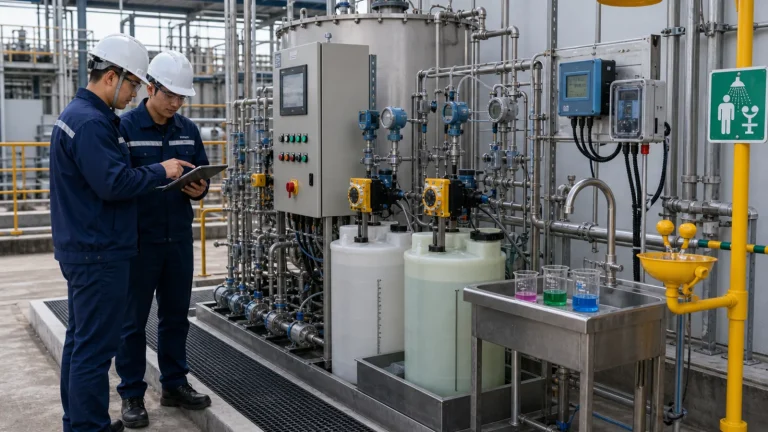
Where pH Neutralization Fits in a Wastewater Plant
Industrial wastewater can shift acidic or alkaline because of cleaning cycles, batch dumping, process chemistry, rinse water, acid pickling, caustic washing, fermentation, chemical precipitation, or product losses. If these streams enter biological treatment, membranes, DAF, or final discharge without control, they can damage equipment and destabilize treatment performance.
Neutralization may be placed at several points: before equalization, after equalization, before biological treatment, before DAF or coagulation, before membrane systems, or near final discharge. The best location depends on wastewater variability, chemical reaction needs, safety risk, and downstream process sensitivity.
1. Start With pH Variability, Not Average pH
Average pH is not enough for design. The team should understand the minimum and maximum pH, frequency of excursions, batch discharge volume, buffering capacity, alkalinity, acidity, temperature, conductivity, suspended solids, oil and grease, and whether acidic and alkaline streams can arrive at the same time.
Two wastewater streams can both have pH 3, but one may require far more caustic because it has much higher acidity or buffering capacity. Likewise, a high-pH stream with strong alkalinity can be harder to neutralize than a lightly alkaline rinse. Bench testing and operating data are valuable because chemical demand is not always obvious from pH alone.
2. Equalization Makes Neutralization More Stable
Neutralization systems operate better when influent changes are buffered. If a strong acid slug reaches the pH probe suddenly, the dosing system may overcorrect, then swing high as mixing catches up. This creates a control loop that chases the wastewater rather than controlling it.
An upstream industrial wastewater equalization tank can reduce flow and pH swings, giving the neutralization system time to respond. Equalization is especially useful for batch industries, cleaning-in-place waste, variable production shifts, and plants where acid and caustic discharges happen at different times.
3. Mixing and Retention Time Are Core Design Parameters
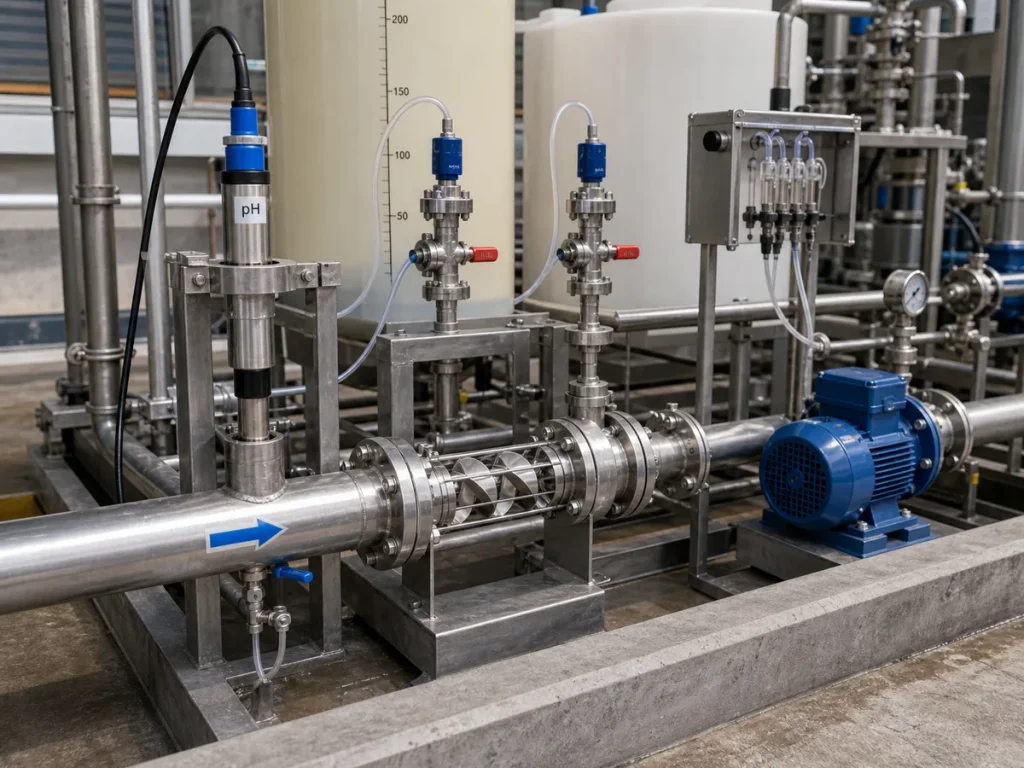
Neutralization is a chemical reaction, but it is also a mixing problem. Acid or caustic must disperse into the wastewater before the pH probe makes a control decision. If the probe is too close to the injection point, it may read a local chemical zone rather than the true mixed condition. If it is too far away, the control response may be slow.
Mixing options include mechanical mixers, recirculation loops, static mixers, jet mixing, or staged neutralization tanks. The choice depends on flow, tank volume, reaction time, wastewater solids, scaling risk, maintenance access, and required control accuracy. A well-designed system defines where chemical enters, how it mixes, where pH is measured, and how long the reaction has before discharge.
4. Acid and Caustic Selection Should Match Site Reality
Common neutralization chemicals include sulfuric acid, hydrochloric acid, carbon dioxide, sodium hydroxide, lime slurry, sodium carbonate, and other project-specific reagents. Selection should consider safety, chemical strength, reaction products, scaling, corrosion, storage requirements, availability, cost, heat release, operator familiarity, and downstream impact.
Sulfuric acid may be economical but can contribute sulfate and heat release during dilution. Hydrochloric acid can create chloride-related corrosion issues. Caustic soda is widely used but hazardous and can overcorrect quickly. Lime may be lower cost in some applications but creates slurry handling, scaling, and solids management challenges. Carbon dioxide can provide gentler pH control in some alkaline streams but needs gas handling and contact design.
5. Probe Placement and Maintenance Decide Reliability
pH probes are small items with large operating impact. They need representative sample contact, adequate flow, temperature compatibility, chemical compatibility, easy removal, calibration access, and protection from coating, fouling, air pockets, solids abrasion, and stagnant zones. A probe installed in a dead pocket can make the control system appear unstable even when dosing pumps are working correctly.
Many plants benefit from two pH measurement points: one for control and one for verification or final compliance. Where risk is high, redundant probes, sample chambers, automatic cleaning, or manual grab-sample checks may be justified. Operators should be able to calibrate probes safely without dismantling piping or reaching into unsafe areas.
6. Control Logic Should Prevent Overshoot
pH control is nonlinear. A small chemical addition can cause a large pH change near neutral pH, while highly buffered wastewater may respond slowly. Simple on-off dosing can work in low-risk systems, but variable flows and strong waste streams often require proportional control, staged dosing, deadbands, feed-forward signals, or cascade logic.
The control sequence should define high and low pH alarms, dosing limits, pump interlocks, chemical low-level alarms, no-flow shutdown, mixer failure response, probe fault response, recirculation requirements, and discharge hold logic. Without these safeguards, a failed probe or empty chemical tank can lead to non-compliant discharge or downstream upset.
7. Chemical Storage and Containment Are Part of the Process
Chemical storage is not only a safety requirement. It affects operation. Tanks, day tanks, transfer pumps, metering pumps, valves, vents, fill points, spill containment, eyewash stations, emergency showers, drains, ventilation, and delivery access should be coordinated before procurement. Chemical unloading should not require temporary hoses across walkways or manual handling that exposes operators to concentrated acid or caustic.
Materials should match the chemical and concentration. PVC, CPVC, HDPE, PP, FRP, stainless steel, rubber-lined steel, and specialty alloys may all be relevant depending on the service. Gaskets, seals, injection quills, calibration fittings, and pump wetted parts should be checked, not assumed.
8. Neutralization Affects DAF, MBR and Downstream Treatment
pH control can support other treatment steps. Coagulation and DAF performance often depend on pH, so a neutralization system may be needed before dissolved air flotation DAF pretreatment. Biological treatment and nitrification also need a suitable pH range, making neutralization important before activated sludge, MBR, or other biological systems.
For membrane bioreactor MBR systems, pH swings can affect biology, membrane compatibility, scaling potential, cleaning frequency, and effluent quality. Neutralization should therefore be designed as part of the full process train rather than as an isolated skid.
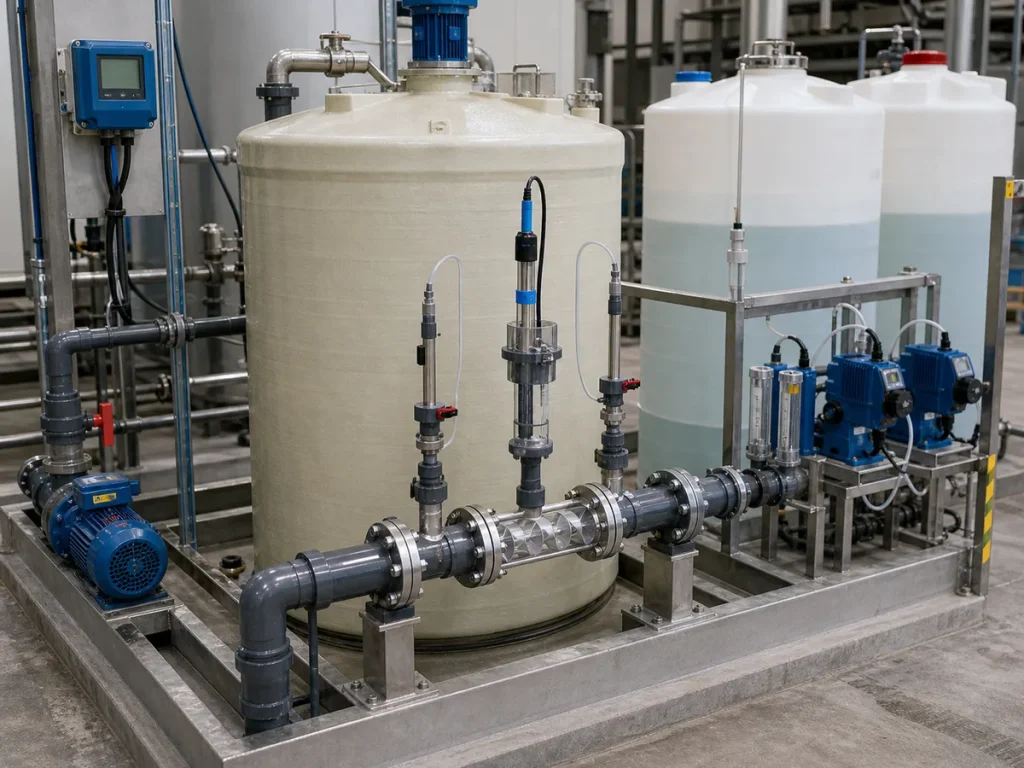
9. Instrumentation Should Help Operators Diagnose Problems
A useful neutralization system may include influent flow, tank level, mixer status, recirculation flow, pH control probe, pH final probe, temperature, chemical tank level, dosing pump speed, dosing flow, pump stroke feedback, calibration status, high and low pH alarms, and chemical containment leak detection where appropriate.
Operators need enough information to distinguish probe fouling, chemical depletion, weak mixing, flow surges, wrong chemical strength, blocked injection lines, and true wastewater changes. Without those signals, the usual response is to increase chemical dose, which can create cost, overshoot, and downstream problems.
10. EPC Layout Should Support Safe Maintenance
Neutralization systems require frequent operator interaction: calibration, chemical delivery, pump inspection, tubing replacement, strainer cleaning, sample checks, and probe removal. The layout should provide access without stepping over containment curbs, reaching across chemical lines, or working in front of unsafe discharge points.
Common layout checks include chemical unloading route, forklift or drum handling, secondary containment volume, drain isolation, ventilation, emergency shower distance, eyewash visibility, lighting, pipe support, probe removal clearance, calibration bench location, and separation of incompatible chemicals.
11. Commissioning Should Use Realistic Wastewater Conditions
Clean water commissioning can confirm leaks, pump rotation, valve position, electrical signals, and instrument loops, but it cannot prove neutralization performance. The system should be tested with representative wastewater or controlled startup conditions so the team can tune dosing range, mixing time, control deadband, alarm limits, recirculation, and discharge hold logic.
Startup records should capture influent pH, flow, chemical dose, final pH, probe calibration, alarm testing, chemical tank levels, operator adjustments, and any abnormal batch events. These records help the owner understand the control strategy and avoid relying on trial-and-error after handover.
pH Neutralization EPC Checklist
- Review pH range, buffering capacity, acidity or alkalinity, batch volume, flow variation, and temperature before sizing the system.
- Use equalization where pH swings or batch discharges would make direct control unstable.
- Define chemical injection points, mixing method, retention time, and pH probe locations together.
- Select acid and caustic chemicals based on safety, corrosion, scaling, reaction products, availability, and downstream impact.
- Provide pH probes that are accessible for cleaning, calibration, removal, and verification.
- Use control logic that prevents overshoot, chemical overfeed, no-flow dosing, and discharge during probe faults.
- Coordinate chemical storage, fill points, containment, ventilation, eyewash, emergency shower, and safe access.
- Check wetted materials for chemicals, wastewater chemistry, temperature, seals, gaskets, and injection fittings.
- Instrument the system so operators can diagnose mixing, dosing, probe, and chemical supply problems.
- Commission with representative wastewater and document final tuning parameters.
Common Mistakes to Avoid
The first mistake is designing from average pH instead of acid or caustic demand under real batch conditions. The second is placing the pH probe too close to the injection point or in a poorly mixed zone. The third is using simple on-off dosing where the process needs proportional or staged control. The fourth is underestimating chemical safety, containment, unloading, and maintenance access.
Another common mistake is treating neutralization as a small skid instead of a process control step that affects DAF, biological treatment, membranes, final discharge, and operator safety. Poor neutralization design often shows up as chemical waste, pH overshoot, alarm fatigue, downstream upset, or hard-to-maintain chemical areas.
Conclusion
Industrial wastewater pH neutralization is a practical EPC design problem. It requires accurate wastewater data, suitable equalization, proper chemical selection, reliable mixing, maintainable probes, stable control logic, safe chemical handling, and realistic commissioning.
When these elements are engineered together, the neutralization system becomes a stable process control point. When they are treated separately, even a simple pH adjustment step can become a source of daily operating risk.