
Storage tanks do not always hold a uniform liquid. Density difference, temperature gradients, entrained solids, water bottoms, waxes, additives, batch changes, long residence time, and low turnover can produce stratification, sediment, concentration variation, or product layers. In some services that affects product quality; in others it affects pumpability, measurement, heating performance, emissions, corrosion, or the ability to transfer the intended material.
Tank mixing and recirculation are ways to control those conditions, but they are not interchangeable and they should not be oversized by default. The right system starts with a clear process objective: blend ingredients, keep solids suspended, homogenize density or temperature, prevent local cooling, disperse an additive, resuspend settled material before transfer, or avoid dead zones. Each objective requires a different understanding of the liquid and the tank.
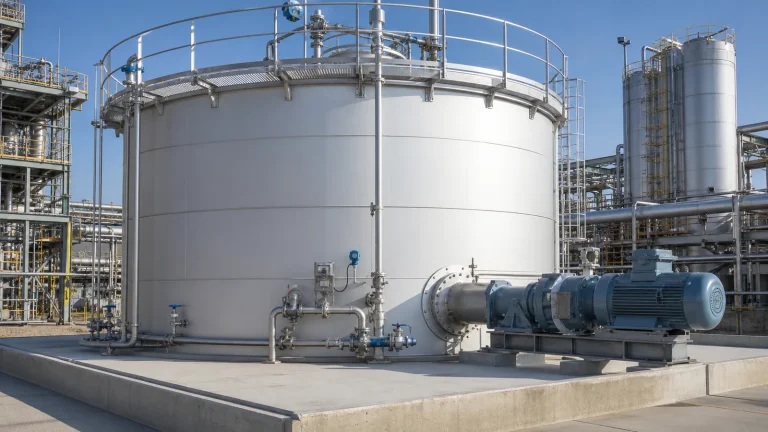
Define the Mixing Objective First
“Provide a mixer” is not a sufficient design basis. The process team should specify what good mixing means in measurable terms. Examples include a required blend uniformity, maximum concentration variation, solids suspension criterion, temperature difference between points, time to disperse an additive, allowable sediment depth, or time needed to recondition a tank before dispatch.
Different liquids behave differently. Low-viscosity miscible liquids may blend with modest circulation. High-viscosity products may need more controlled shear, heating, or recirculation. Solids suspension depends on particle size, density, settling velocity, concentration, shape, and the risk of abrasion. Emulsions and sensitive products can be damaged by too much shear. A mixer sized to suspend heavy solids may not be suitable for a fragile emulsion.
Data Needed for Equipment Selection
The design input should include tank diameter and liquid height, normal and minimum operating levels, tank roof and bottom geometry, liquid density, viscosity across the operating temperature range, vapor pressure, flash point where relevant, solids concentration and particle size, blend components, expected turnover, heating arrangement, allowable product shear, and cleaning requirements. It should also identify whether the tank can be taken out of service for maintenance and how the mixer will be removed or repaired.
Operational details matter as much as laboratory data. A tank that receives one product continuously behaves differently from a batch tank that receives several additives at once. A tank that sits for weeks may require re-suspension before transfer. A heated tank may need circulation to avoid hot zones. A tank that shares a manifold may need a controlled sequence so mixing does not send product to the wrong destination.
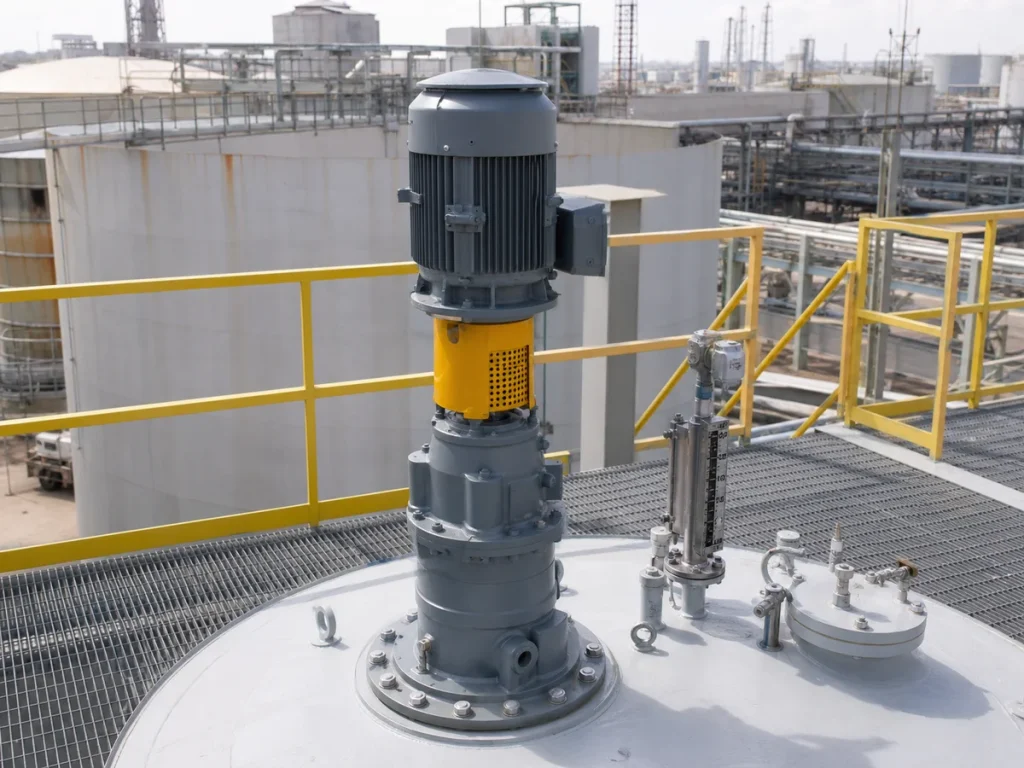
Top-Entry Agitators
Top-entry agitators place the drive, gearbox, shaft, and impeller through the tank roof. They can provide a well-defined vertical mixing pattern and may suit blending, solids suspension, or high-viscosity service when the tank roof and internal configuration support them. Impeller type, diameter, speed, shaft length, baffles, and location influence circulation pattern and power draw.
The roof structure, mixer support, nozzle reinforcement, platform, lifting arrangement, shaft seal, coupling guard, electrical isolation, and maintenance access must be part of the scope. A small access opening that is adequate for inspection may not be adequate to remove a long shaft or large impeller. Roof deflection, shaft alignment, vibration, and seal leakage should be checked during commissioning and after major tank modifications.
Side-Entry Mixers
Side-entry mixers mount through the tank shell, usually at a lower elevation, and direct flow around the tank bottom or across the bulk liquid. They are common where large-diameter tanks need circulation, blending, temperature uniformity, or sediment control without a central shaft entering through the roof. Directional adjustment can help develop a circulation pattern suited to the tank geometry and operating level.
Because the mixer enters through the shell, its nozzle, reinforcement, isolation valve, seal, mechanical drive, and external support deserve special attention. The assembly adds local weight, dynamic vibration, and piping or electrical interfaces to a structural zone that must remain leak-tight. Designs should be coordinated with the tank nozzle, pipe support, and access interfaces, including the ability to isolate, remove, and maintain the mixer without exposing people to product or leaving the tank uncontrolled.
Jet Mixing and Pumped Recirculation
Jet mixing uses a recirculation pump and nozzles to return liquid into the tank at a controlled velocity. The jet entrains surrounding liquid and can create bulk circulation without an internal rotating shaft. This approach may be attractive where a pump is already required for transfer or where internal mechanical equipment is undesirable. It can also be used with eductors, multiple nozzles, or a designed return manifold.
The loop must be designed as a hydraulic system, not just a pump connected to a return nozzle. Pump suction conditions, minimum flow, NPSH margin, flow control, nozzle pressure loss, line velocity, erosion risk, valve positions, bypasses, strainers, instrument locations, pipe supports, isolation, and drainage all affect performance. A loop that produces high pressure at the pump but little useful circulation in the tank will waste energy without solving the process problem.
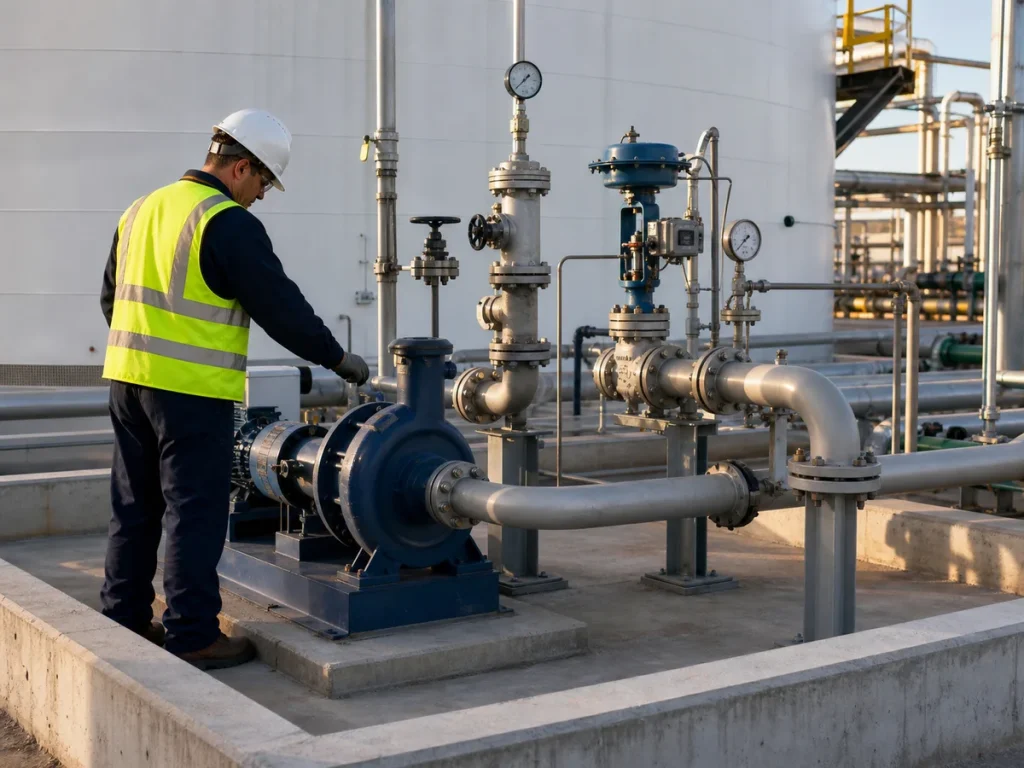
Stratification and Dead Zones
Stratification can be thermal, density-driven, concentration-driven, or caused by poor inlet and outlet locations. A warm layer may form near a heater while colder product remains at the bottom. A light additive may stay near the roof. Heavy solids may collect below the effective mixing zone. Dead zones often occur behind internal obstructions, near the floor edge, under roof columns, around heating coils, or in tanks with poor nozzle placement.
Field evidence is more useful than assumptions. Sampling at several elevations, temperature profiles, density checks, pump suction quality, level behavior, tank-bottom inspection findings, and material balance can reveal whether the desired circulation is occurring. If sampling points are poorly located, a tank can appear uniform on paper while significant variation remains elsewhere.
Mixing and Heated Storage
Heating and mixing should be designed together. Internal coils or external heating zones can create local hot spots, especially in viscous liquids. Circulation spreads heat through the inventory and can reduce the risk of product degradation at the heater surface. However, a mixer should not be used to compensate for an uncontrolled heater or poor insulation. The heating duty, coil temperature, product temperature limit, mixing energy, and warm-up procedure need one control philosophy.
For tanks requiring temperature maintenance, review the tank heating, insulation, and heat-tracing design alongside the mixer selection. The combined system may need level interlocks, pump or mixer permissives, high-temperature shutdown, low-level protection, and a defined sequence for startup after a cold shutdown.
Power, Speed and Variable-Frequency Drives
Mixer power is not simply a larger-is-better number. Excessive power can create vortexing, air entrainment, foam, seal wear, vibration, product degradation, unnecessary energy use, and high nozzle loads. Too little power can leave solids, temperature layers, or concentration gradients untouched. The selected impeller and speed should be matched to the objective and the physical properties expected in the most difficult operating case.
Variable-frequency drives can provide controlled ramp-up, adjustable speed, reduced energy use during holding, and process flexibility. They also require an operating envelope: minimum and maximum speed, resonance avoidance, torque limits, alarm response, and defined settings for different products or levels. A VFD should not become an undocumented way to change the process by trial and error.
Mechanical Integrity and Seal Management
Mixers are rotating assets exposed to product, vibration, weather, and process changes. Inspection should include motor condition, gearbox oil, coupling guard, vibration, shaft alignment, seal leakage, mounting bolts, nozzle reinforcement, support condition, electrical enclosure integrity, and signs of shell distortion or pipe stress. Side-entry seal systems need particular attention because a small leak can progress into a product release or an unplanned shutdown.
Tank inspection reports should record mixer-related observations, including abnormal vibration, coating damage around the nozzle, leakage, support corrosion, or settlement that may have changed alignment. This connects the equipment to the broader above-ground storage tank inspection and maintenance program rather than treating it as an isolated rotating-equipment issue.
Controls, Instrumentation and Operating Procedures
Controls should be designed around the actual hazards and product behavior. Useful signals may include mixer running status, motor load, vibration, seal pressure or leakage indication, pump flow, discharge pressure, tank level, product temperature, and valve position. Interlocks may be needed to prevent dry running, operation below a safe level, starting against a closed valve, operating when a maintenance isolation is active, or energizing a system during tank entry.
Operating procedures should state when to start mixing, how long to run, whether mixing continues during receiving or withdrawal, how to condition the tank before sampling or transfer, and what to do after an alarm. They should also define precautions for additive addition, low level, high viscosity, product changeover, and loss of power. The operating record becomes valuable evidence when a product-quality problem or sediment issue is investigated.
Maintenance Isolation and Tank Entry
Rotating equipment adds a serious energy-isolation requirement. Before servicing a mixer, recirculation pump, valve actuator, or any associated internal equipment, teams need to isolate electrical, mechanical, hydraulic, pneumatic, thermal, and process energy as applicable. A local stop button alone may not protect someone from unexpected restart or stored rotation. Tank entry adds further confined-space, process isolation, ventilation, and rescue requirements.
The isolation plan should identify the actual energy sources, including the motor starter or VFD, gearbox rotation, line pressure, recirculation pump, bypasses, automated valves, and any linked control logic. The plan needs verification before work begins and a controlled return-to-service sequence after maintenance. This is especially important when multiple contractors are working around a tank during an outage.
EPC Design and Commissioning Checks
The EPC package should include the process mixing basis, liquid properties, tank geometry, mixer or jet-mixing data sheet, hydraulic or mixing study, motor and gearbox details, seal plan, nozzle and roof-load review, electrical classification, VFD or starter drawings, control narrative, interlocks, instrumentation, piping and support drawings, lifting and maintenance access, isolation procedure, and spare-parts plan.
Commissioning should verify rotation direction, vibration, motor load, flow and pressure where applicable, seal condition, alarm response, correct interlocks, accessible isolation, product response, and safe operating range. A meaningful acceptance test should demonstrate the desired mixing result, such as sampling consistency, temperature uniformity, solids suspension, or blend time, rather than only proving that the motor runs.
Tank Mixing and Recirculation Checklist
- Define the process objective and measurable acceptance criterion before selecting equipment.
- Use real liquid properties, operating levels, solids data, temperature range, tank geometry, and turnover conditions.
- Select top-entry, side-entry, jet mixing, or recirculation based on the objective, not a generic motor size.
- Review roof loads, shell nozzles, reinforcement, pipe supports, platforms, lifting access, and maintenance removal paths.
- Design recirculation loops for pump protection, hydraulic performance, isolation, drainage, pressure, supports, and valve access.
- Check for thermal or density stratification, bottom sediment, dead zones, air entrainment, vortexing, and product shear risk.
- Coordinate mixing with heating, level, temperature, transfer, sampling, and product-change procedures.
- Monitor vibration, motor load, seals, gearbox condition, pump performance, and nozzle integrity.
- Apply verified energy isolation before maintenance or tank-entry work.
- Commission against a process outcome, not only against motor rotation or pump pressure.
Key Takeaway
A storage tank mixer or recirculation loop succeeds when it solves a defined product problem with a maintainable mechanical and control system. The best design connects liquid behavior, tank geometry, nozzle and roof loads, heating, hydraulic performance, operating procedures, inspection data, and safe isolation. That approach prevents the familiar failure mode of installing equipment that runs reliably but does not actually mix the tank.