
Storage tank roof design is often treated as a secondary detail after capacity, material, and shell thickness are selected. That is a mistake. The roof system affects vapor control, pressure relief, emissions, fire protection, rainwater drainage, corrosion risk, inspection access, maintenance workload, and even the practical operating envelope of the tank.
For EPC projects, a tank roof should be selected from stored liquid properties, vapor pressure, filling and withdrawal rates, weather exposure, fire strategy, environmental requirements, access needs, and long-term inspection planning. A roof that looks acceptable on a general arrangement drawing can still create serious problems if vent sizing, drainage, seals, fittings, or maintenance access are not coordinated early.
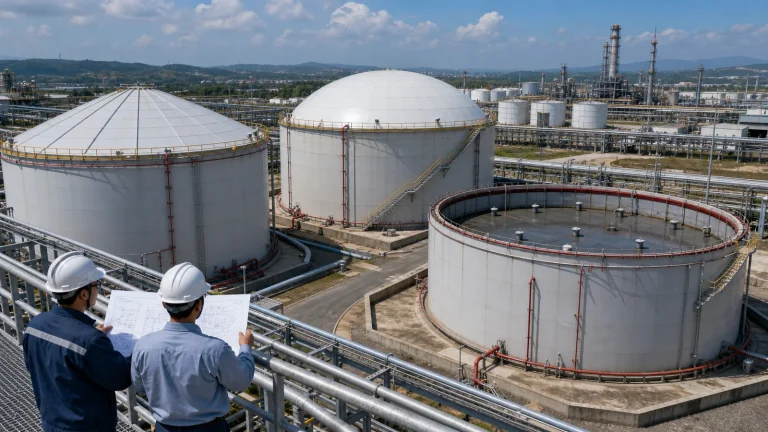
Start With the Stored Liquid and Operating Mode
The first roof decision should be based on what the tank stores and how it operates. Water, wastewater, fire water, process water, mild chemicals, oils, fuels, solvents, acids, alkalis, slurries, and volatile organic liquids all place different demands on the roof. A tank storing non-volatile water may need weather protection, access, corrosion control, and overflow planning. A tank storing volatile liquid may need careful vapor control, normal venting, emergency venting, floating roof evaluation, or vapor recovery.
Filling rate and withdrawal rate are just as important as stored liquid type. A tank that fills quickly must allow vapor or air to leave without overpressure. A tank that empties quickly must allow air or blanketing gas to enter without vacuum damage. Thermal breathing from daily temperature change can also create repeated inbreathing and outbreathing, even when pumps are not running.
This is why roof design belongs near the beginning of industrial storage tank selection, not after the shell and nozzles have already been frozen.
Fixed Roof Tanks: Cone, Dome and Supported Roofs
Fixed roof tanks include cone roofs, dome roofs, umbrella roofs, supported roofs, and self-supporting roofs. They are common for water, wastewater, fire water, process liquids, many chemicals, and low-volatility products. A fixed roof protects the contents from weather, reduces contamination, supports roof accessories, and provides a defined vapor space above the liquid.
The main advantage of fixed roofs is simplicity. The roof is structurally connected to the shell and can support vents, hatches, platforms, instruments, foam chambers, sampling points, and other accessories. The main limitation is that a vapor space remains above the liquid. If the liquid is volatile or flammable, that vapor space must be managed through venting, inerting, vapor recovery, floating roof internals, or other controls depending on the service.
Dome Roofs and Aluminum Geodesic Roofs
Aluminum dome roofs are often used for large storage tanks where a lightweight, corrosion-resistant, self-supporting roof is useful. They are common on water tanks, wastewater tanks, bulk liquid tanks, and some retrofits over external floating roof tanks. A dome roof can reduce internal columns, lower roof dead load, improve rain shedding, and reduce coating maintenance compared with some steel roof alternatives.
However, dome roofs still require careful interface design. The shell compression ring, wind and seismic loads, roof vents, access hatches, appurtenances, lightning protection, foam systems, and internal floating roof compatibility must be checked. Retrofit dome projects also need dimensional survey and shell condition review before procurement.
External Floating Roof Tanks
An external floating roof tank has a roof deck that floats directly on the stored liquid surface. This reduces the vapor space above volatile liquids and can reduce vapor losses compared with a fixed roof tank without internal controls. External floating roofs are common in petroleum and certain volatile organic liquid storage applications.
The roof is exposed to weather. Rainwater, snow, sunlight, wind, corrosion, seal wear, deck fittings, roof legs, drain systems, and rolling ladders all become part of the maintenance reality. The roof must rise and fall smoothly as the tank fills and empties. If the roof drain blocks or a seal fails, the problem can become both an environmental and mechanical issue.
Internal Floating Roof Tanks
An internal floating roof tank combines a fixed roof with a floating deck inside the tank. The fixed roof blocks weather, while the internal floating roof reduces vapor space above the stored liquid. This arrangement is often used where vapor control is needed but the owner wants to protect the floating deck from weather exposure.
Internal floating roofs bring their own requirements: circulation vents in the fixed roof, rim seals, deck fittings, support legs, access openings, inspection planning, compatibility with columns if the fixed roof is supported, and procedures for landing the roof safely. The fixed roof does not automatically eliminate vapor concerns; it changes how vapor is managed and inspected.
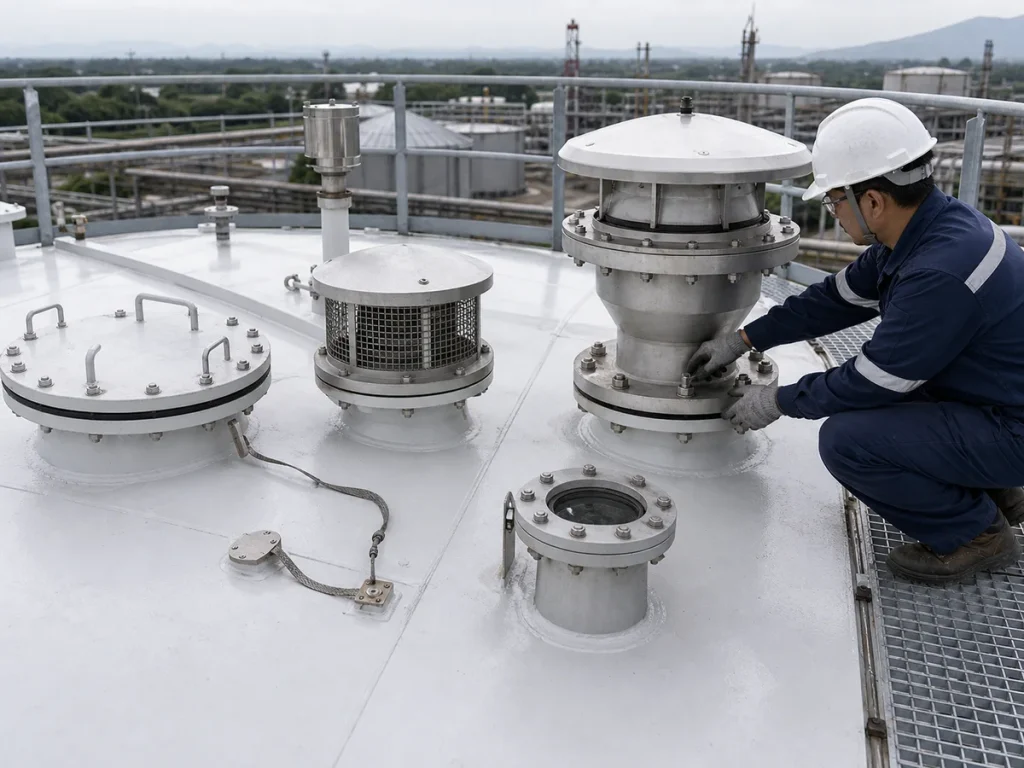
Normal Venting: Breathing During Operation
Normal venting handles routine inbreathing and outbreathing caused by filling, emptying, temperature change, vapor generation, and atmospheric pressure changes. A fixed roof tank without adequate normal venting can be damaged by overpressure during filling or by vacuum during withdrawal. Thin-shell atmospheric tanks are not pressure vessels, so small pressure errors can matter.
Normal venting design should review maximum filling rate, maximum withdrawal rate, pump trip scenarios, thermal breathing, vapor pressure, blanketing gas flow, pressure-vacuum vent settings, flame arresters where required, vent piping pressure loss, and weather protection. Vent devices should be accessible for inspection and maintenance because fouling, corrosion, freezing, paint, insects, or damaged pallets can reduce capacity.
Emergency Venting: Fire and Abnormal Heat Input
Emergency venting is intended for abnormal events such as external fire exposure or other heat input that can rapidly increase vapor generation. The emergency vent path may be through dedicated emergency vents, larger relief devices, weak roof-to-shell seams in certain tank designs, or other approved methods depending on the applicable standard and project requirements.
The key EPC point is that emergency venting is not a generic accessory. It must be evaluated against tank design pressure, stored liquid, wetted surface, fire case assumptions, vent device capacity, flame exposure, insulation, roof configuration, and applicable codes. If the tank is modified later with a dome roof, vapor recovery system, blanket gas system, or new roof attachments, emergency venting assumptions should be rechecked.
Flame Arresters, Conservation Vents and Vapor Control
Some fixed roof tanks use pressure-vacuum vents to reduce routine breathing losses while protecting against damaging pressure or vacuum. Flame arresters may be required in certain flammable vapor services, but they also add pressure drop and maintenance requirements. Vapor recovery or treatment systems may be used where emissions, odor, product loss, or safety requirements justify them.
These devices must be treated as a system. A flame arrester that plugs or a vapor recovery header that creates backpressure can change the tank’s operating risk. EPC design should include isolation philosophy, bypass policy, condensate drainage, inspection access, testing procedures, instrument alarms, and winterization where needed.
Roof Nozzles, Instruments and Access Openings
Tank roofs often carry gauge hatches, radar level instruments, pressure-vacuum vents, emergency vents, foam chambers, sample hatches, manways, nitrogen blanketing connections, vapor return nozzles, odor control connections, mixers, roof drains, and inspection openings. Each penetration affects structural load, corrosion risk, gasket selection, coating repair, access, and leak potential.
This is where roof design connects directly with tank nozzle, pipe support and access design. A roof accessory that cannot be reached safely may not be maintained. A vent placed too close to a platform, wall, roof edge, or vapor source can create operational problems. Instrument nozzles should be coordinated with internal floating roof movement, mixer zones, foam systems, and calibration access.
Rainwater Control on Fixed Roofs
Fixed roofs should shed rainwater without ponding. Cone slope, dome geometry, roof plate stiffness, settlement, wind effects, plugged drains, and local depressions can all affect water retention. Standing water increases corrosion risk, coating deterioration, ice load in cold climates, and roof deformation.
Roof appurtenances should not create water traps. Platforms, supports, insulation terminations, vent bases, and reinforcing pads need details that avoid crevice corrosion and coating failure. Where tanks store corrosive liquids or are located in marine or industrial atmospheres, external roof coating and drainage become even more important.
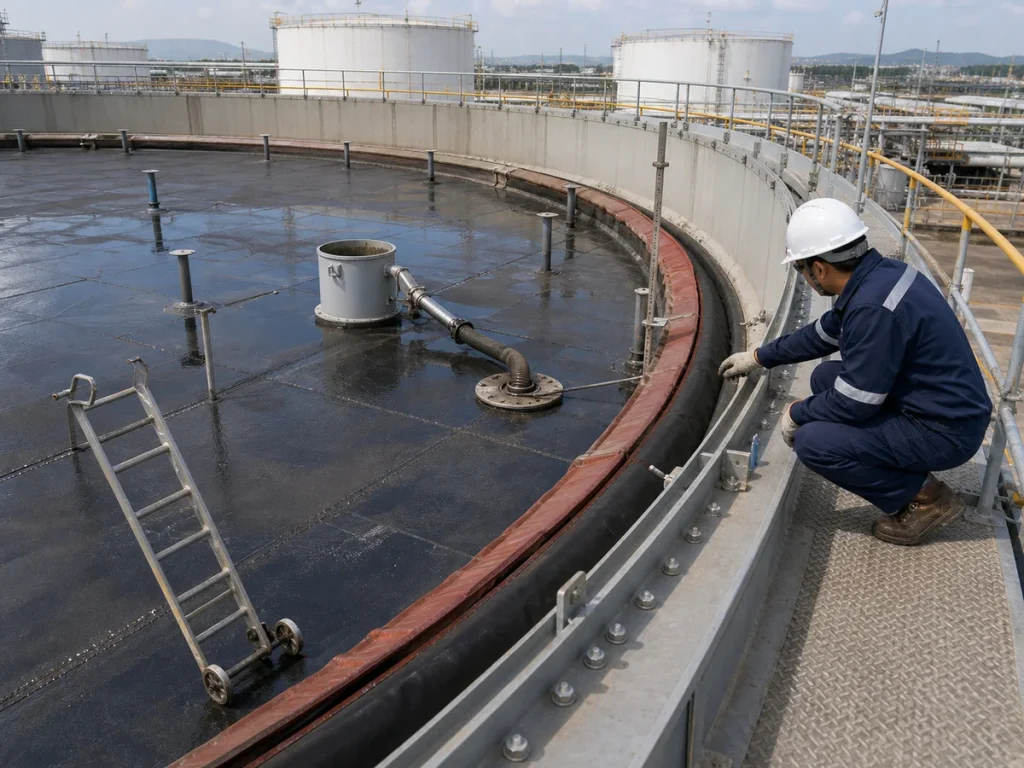
Rainwater Control on Floating Roofs
External floating roofs must manage rainwater because the deck is exposed. Drainage may use flexible hoses, articulated drains, or other systems routed through the tank to the shell outlet. Drain reliability is critical: a blocked or leaking roof drain can allow water to accumulate on the floating roof, reduce buoyancy margin, overload the deck, contaminate product, or create corrosion and safety issues.
Floating roof design should review deck slope, drain capacity, sump arrangement, check valves, hose compatibility, articulated joint maintenance, winter conditions, roof landing scenarios, and inspection access. Operators should have a clear procedure for checking roof drain performance after heavy rain and before abnormal weather.
Floating Roof Seals and Deck Fittings
Floating roof emission and safety performance depends heavily on rim seals, deck fittings, gauge wells, sample wells, support legs, drains, and other openings. Primary and secondary seals must tolerate roof movement, shell out-of-roundness, wind, product compatibility, weathering, and maintenance activity. Poor seal condition can increase vapor losses and create inspection findings.
Deck fittings should be selected and maintained with the same discipline as the roof itself. Open or poorly sealed fittings defeat the purpose of the floating roof. Inspection programs should include seal condition, deck corrosion, roof legs, drain condition, rolling ladder movement, grounding and bonding, and evidence of product or water accumulation.
Fire Protection and Foam Interface
Roof design affects fire protection. Fixed roof tanks may require foam chambers, vents, emergency relief devices, and access routes that do not conflict. Floating roof tanks may require rim seal fire protection, foam pourers, detection, drainage, and access for emergency response. The roof type influences credible fire scenarios, vapor space, rim seal exposure, and firefighting approach.
EPC teams should coordinate tank roof details with the site fire protection philosophy early. Late changes to foam chambers, roof vents, platforms, or seal systems can affect roof reinforcement, nozzle layout, drainage, and maintenance access.
Roof Selection and Tank Construction Method
Roof options are also influenced by construction method. Bolted tanks, welded tanks, glass-fused-to-steel tanks, stainless tanks, and lined tanks may use different roof systems and accessory details. A bolted steel tank may use modular roof panels and factory-coated details, while a field-welded tank may use welded steel roof plates, aluminum domes, or floating roof systems depending on service.
When comparing bolted steel tanks and welded steel tanks, roof requirements should be part of the comparison. The shell type may be acceptable, but the roof, vents, hatches, platforms, and future inspection access may decide whether the package works for the project.
Inspection and Maintenance Checks
Roof inspection should include external corrosion, coating breakdown, ponding, deformation, settlement effects, vent condition, blocked flame arresters, gasket condition, hatch sealing, emergency vent movement, roof nozzle corrosion, platform supports, bonding jumpers, lightning protection, seal condition, floating roof drain function, deck corrosion, roof legs, and evidence of vapor or liquid leakage.
Some inspections can be done externally during operation. Others require outage planning, gas testing, confined space procedures, internal access, or specialized inspection. The maintenance plan should be defined before handover, not discovered after the first vent sticks or the first floating roof drain leaks.
Storage Tank Roof EPC Checklist
- Confirm stored liquid, vapor pressure, temperature range, filling rate, withdrawal rate, thermal breathing, and abnormal operating cases.
- Select fixed roof, dome roof, external floating roof, internal floating roof, or other roof type based on service and operating risk.
- Size normal venting for filling, emptying, thermal breathing, vapor generation, and blanketing gas where applicable.
- Review emergency venting for credible fire exposure and abnormal heat input cases.
- Check pressure-vacuum vents, flame arresters, vapor recovery connections, emergency vents, and roof hatches as one system.
- Coordinate roof nozzles, instruments, foam chambers, platforms, ladders, handrails, and maintenance access before procurement.
- Design fixed roof slope, coatings, supports, and appurtenance details to avoid ponding and corrosion traps.
- Design floating roof seals, deck fittings, roof drains, rolling ladders, roof legs, and inspection access for long-term operation.
- Coordinate roof design with fire protection, emissions control, lightning protection, grounding and bonding, and site operating procedures.
- Define inspection, cleaning, testing, spare parts, and maintenance responsibilities before handover.
Common Mistakes to Avoid
The first mistake is selecting a roof type from habit rather than stored liquid and operating mode. The second is treating vent devices as accessories rather than safety-critical equipment. The third is forgetting rainwater: ponding on fixed roofs and drain failure on floating roofs can create expensive long-term problems.
Another common mistake is freezing roof nozzles and platforms before maintenance access is reviewed. A vent that cannot be inspected safely will not be maintained well. A floating roof drain that cannot be tested or repaired easily will eventually become an operating risk.
Conclusion
Storage tank roof design is a core part of industrial tank engineering. Fixed roofs, dome roofs, external floating roofs, internal floating roofs, vents, flame arresters, emergency vents, rainwater drains, seals, hatches, platforms, and instruments all influence tank safety and reliability.
For EPC projects, the right approach is to define the operating case first, then coordinate roof structure, vapor control, pressure relief, drainage, access, fire protection, inspection, and maintenance. When roof design is handled early, the tank is easier to operate, safer to maintain, and less likely to create late-stage project changes.