
Bolted steel tanks and welded steel tanks are both widely used in industrial storage projects. The difference is not simply that one is faster and the other is stronger. The real decision involves stored liquid, tank size, design standard, coating system, site access, labor availability, inspection plan, foundation tolerance, nozzle loads, long-term maintenance, and whether the owner may need future expansion or relocation.
For EPC teams, the wrong choice can create problems long before the tank is filled. A bolted tank can suffer from poor gasket selection, coating damage, uneven foundation support, loose assembly control, or nozzle misalignment. A welded tank can suffer from field weld defects, distortion, coating schedule delays, weather exposure, NDE bottlenecks, or difficult site logistics. The best selection starts with project conditions rather than a default preference.
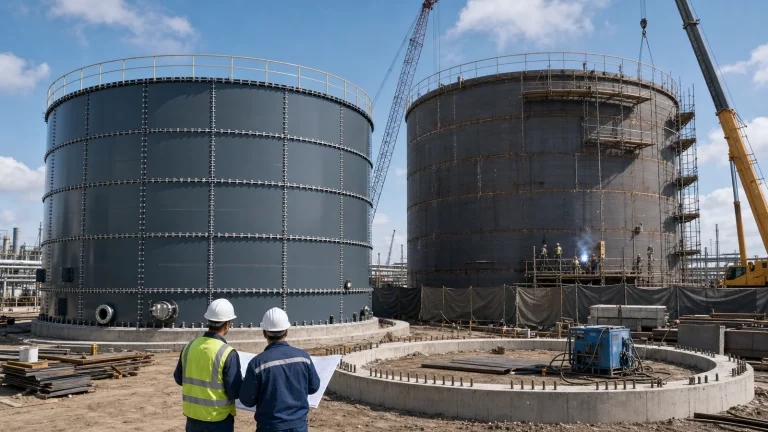
What Is a Bolted Steel Tank?
A bolted steel tank is assembled from prefabricated steel panels or shell sections using bolts, gaskets, sealants, stiffeners, anchor details, and a roof system. Many bolted tanks use factory-applied coatings such as glass-fused-to-steel, powder coating, epoxy, or other protective systems. Because panels are fabricated and coated before delivery, the field work focuses on foundation checking, panel erection, bolt tightening, gasket continuity, nozzle installation, roof assembly, and leak testing.
Bolted construction is commonly used for water storage, wastewater storage, fire water, process water, leachate, certain dry bulk or slurry services, and industrial utility tanks. Standards such as AWWA D103 are often associated with factory-coated bolted carbon steel tanks for water storage. In practice, the project specification must still define service conditions, coatings, gaskets, nozzles, roof loads, seismic and wind loads, foundation type, accessories, inspection requirements, and warranty scope.
What Is a Welded Steel Tank?
A welded steel tank is fabricated from steel plates that are welded together either in the shop for smaller tanks or in the field for large above-ground tanks. Field-welded vertical cylindrical tanks are common for petroleum products, chemicals, industrial water, fire water, wastewater, and many large-volume applications. API 650 is a well-known standard for welded tanks for oil storage, but industrial projects may also use other codes or owner specifications depending on service, pressure, temperature, and regulatory requirements.
Welded construction gives designers flexibility in diameter, height, bottom configuration, roof type, shell thickness, nozzles, manways, internal details, and large custom layouts. It also makes field quality control central to project success: weld procedures, welder qualification, plate fit-up, dimensional control, NDE, vacuum box testing, coating preparation, and hydrostatic testing all matter.
1. Service Conditions Come First
The stored liquid should drive the first screening decision. Potable water, fire water, process water, wastewater, mild chemicals, acids, alkalis, fuels, solvents, oils, slurries, digestate, or corrosive industrial liquids all impose different requirements on steel grade, coating, gasket material, roof design, venting, nozzles, cleanability, and inspection.
A bolted tank with a factory coating can be excellent for many water and wastewater services when the coating and gasket system are compatible with the liquid. However, aggressive chemicals, solvents, high temperatures, abrasive slurries, or unusual cleaning procedures may challenge factory coatings and elastomeric seals. A welded tank may be better where a continuous internal lining, alloy material, custom internal details, or heavy-duty service conditions are required.
Material selection should not be separated from construction method. A project comparing carbon steel, stainless steel, FRP, and glass-fused-to-steel should first review the broader tank material selection criteria, then decide whether bolted or welded construction fits the selected material system.
2. Size, Geometry and Capacity Range
Bolted tanks are modular. They are efficient when standard panel sizes, shell courses, and factory coating systems match the required capacity. They can often be shipped in containers or flat packs, which is useful for remote sites or projects with road restrictions. Very large bolted tanks are possible, but diameter, height, wind load, seismic demand, coating type, gasket arrangement, roof system, and erection equipment should be checked carefully.
Welded tanks are highly flexible for large diameters, tall shells, special roofs, floating roofs, cone bottoms, sloped bottoms, annular plates, internal piping, sumps, and custom nozzles. For very large storage, welded construction is often more familiar to owners, inspectors, and tank contractors, especially when the project already uses API-style tank procurement and inspection practices.
3. Coating and Corrosion Protection
Coating is one of the biggest differences. Bolted tanks usually benefit from factory-applied coating under controlled surface preparation, application, curing, and inspection conditions. That can reduce weather risk and improve coating consistency. The tradeoff is that bolt holes, panel edges, gaskets, field touch-up areas, and installation damage must be controlled carefully.
Welded tanks are often coated after erection. Field coating allows continuous treatment across welds and custom details, but it depends heavily on site weather, surface preparation quality, humidity control, dust control, access, holiday testing, curing time, and coating applicator skill. Poor field coating can become the weakest part of an otherwise good welded tank.
The EPC specification should define surface preparation, coating type, dry film thickness, holiday testing, repair procedure, edge treatment, chemical compatibility, UV exposure, immersion service, and expected inspection records. “Coated steel tank” is not enough detail for procurement.
4. Field Installation Speed and Site Logistics
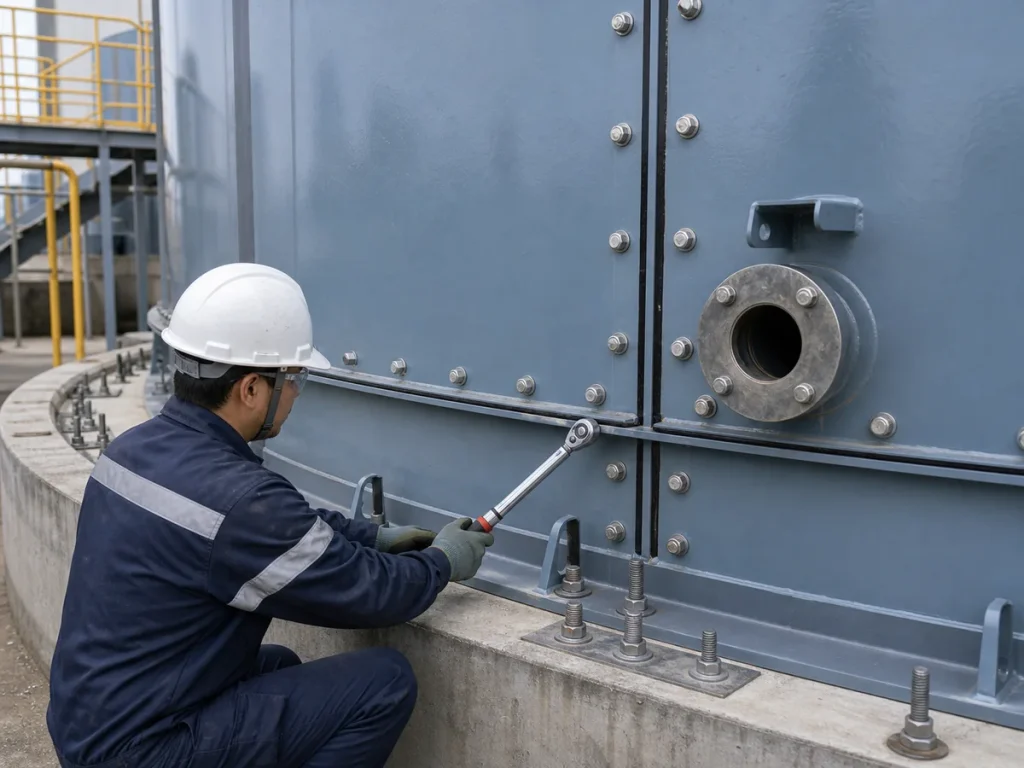
Bolted tanks are often attractive where short installation windows, limited hot work, remote sites, or limited field welding resources are important. Panels arrive ready for assembly, and field work may require less specialized welding labor. This can reduce schedule risk when qualified welders, NDE teams, or field coating crews are difficult to mobilize.
Welded tanks require more field fabrication time, welding equipment, weather protection, fit-up control, scaffolding or jacking systems, inspection access, and often more coating time after shell completion. However, experienced welded tank contractors can execute large tanks efficiently, and welded construction may be more straightforward for heavy-duty custom applications.
Schedule comparison should include foundation readiness, material delivery, crane or jacking method, weld inspection, coating cure, roof installation, nozzle tie-ins, hydrotest water availability, and punch-list repair. A nominally faster tank type can still lose time if the foundation is not ready or if accessories are not coordinated.
5. Foundation Tolerance and Bottom Support
Both tank types require a reliable foundation, but bolted tanks can be particularly sensitive to ringwall levelness, anchor bolt location, embedded plates, floor support, and local unevenness that affects panel alignment or gasket compression. A small foundation tolerance issue may become visible as difficult panel fit-up, bolt-hole misalignment, or seal stress.
Welded tanks also depend on proper foundation design, settlement control, edge support, annular ring details, drainage, and bottom plate support. Settlement can distort the shell, stress nozzles, affect roof alignment, and create long-term inspection issues. Before either type is ordered, EPC teams should confirm geotechnical data and the above-ground storage tank foundation design strategy.
6. Nozzles, Pipe Loads and Access Platforms
Bolted tanks often use prefabricated nozzle panels, reinforced shell details, or field-installed fittings. The nozzle layout should be finalized early because changing a coated bolted panel late in the project can affect coating, reinforcement, delivery, and warranty. Pipe loads should be controlled with external supports and flexible connections where needed.
Welded tanks allow more flexible field nozzle installation, but that flexibility can create interface risk if piping, platforms, instruments, insulation, and civil work are not coordinated. Nozzle reinforcement, shell thickness, weld access, NDE, coating repair, and stress from connected piping all need review.
This is one reason a tank comparison should include the full interface package, not only the shell. The same issues covered in tank nozzle, pipe support and access design often decide whether a tank is easy to install and maintain.
7. Leak Paths and Inspection Philosophy
Bolted tanks have many mechanical joints. Their performance depends on gasket material, bolt spacing, torque, sealant quality, panel surface condition, joint cleanliness, installation sequence, and long-term gasket behavior. Inspection should include panel alignment, gasket continuity, bolt torque records, coating touch-up, penetrations, roof joints, and water testing.
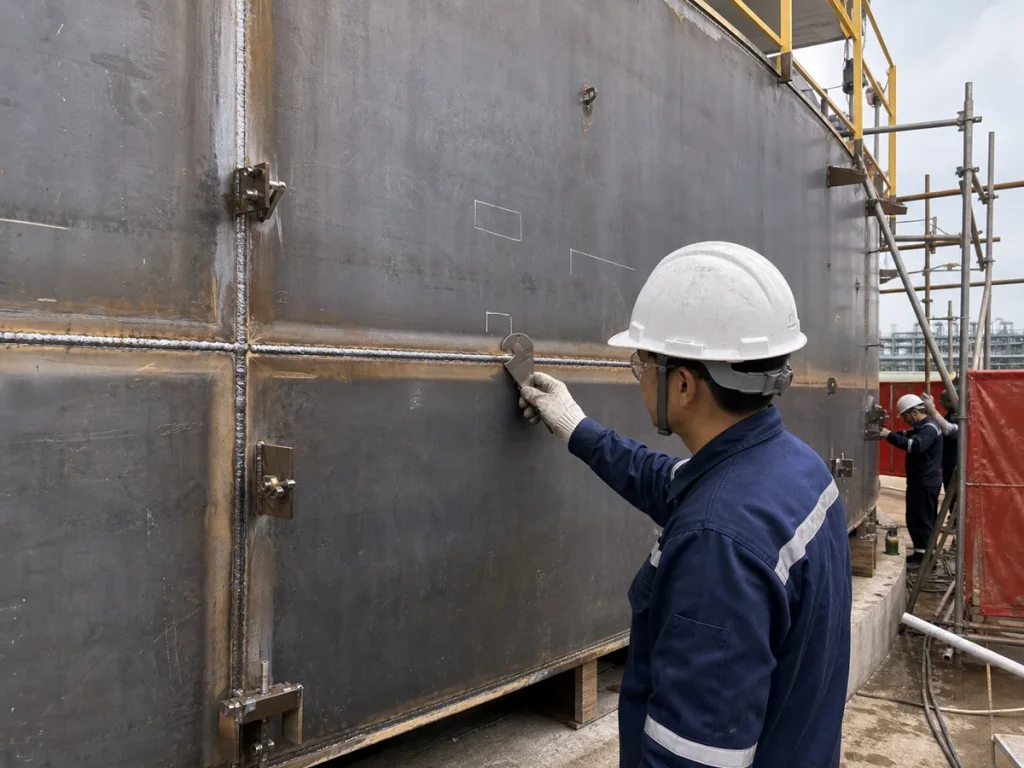
Welded tanks have welded seams instead of bolted seams. Their quality control focuses on weld procedure, welder performance, fit-up, visual inspection, radiographic or ultrasonic testing where required, vacuum box testing for bottoms, penetrant or magnetic particle testing where specified, dimensional checks, and coating inspection. The leak paths are fewer in number but can be more difficult to repair if defects are buried under coatings or inaccessible details.
8. Maintenance and Long-Term Ownership
Bolted tanks can offer practical advantages for future modification. Some designs can be expanded, repaired by replacing panels, or even relocated, depending on service, age, coating condition, and manufacturer rules. The owner should still expect periodic checks for gasket aging, bolt condition, coating damage, corrosion at seams, roof details, and anchor areas.
Welded tanks are usually permanent assets. They can be inspected, repaired, lined, recoated, patched, and modified by qualified tank contractors. For large welded tanks, in-service inspection programs, settlement surveys, shell thickness readings, bottom inspection, roof condition checks, and coating maintenance become part of asset management.
The better choice depends on what the owner values: modularity and factory coating, or custom welded construction and a more traditional large-tank inspection model.
9. Cost Comparison Should Include More Than Tank Price
A fair comparison should include tank supply, freight, foundation, anchors, erection labor, cranes or jacks, field welding, NDE, coating, touch-up, hydrotest, cleaning, commissioning, site supervision, permits, hot-work controls, schedule delay risk, future inspection, and maintenance. A cheaper shell price can be outweighed by more expensive field work or long-term coating repairs.
Bolted tanks may reduce field labor and coating exposure but can have higher factory fabrication or coating cost depending on system and supplier. Welded tanks may offer lower material cost for some large sizes but require more field fabrication, inspection, and coating management. EPC teams should compare installed and commissioned cost, not just purchase order cost.
10. Procurement Questions for EPC Teams
- Which design standard or owner specification governs the tank, and what optional requirements must be defined?
- Is the stored liquid compatible with the selected steel, coating, gasket, lining, sealant, and cleaning method?
- Are diameter, height, roof type, bottom design, nozzles, manways, overflow, venting, instruments, and platforms fixed before procurement?
- Can the site support field welding, coating, NDE, crane access, hydrotest water, drainage, and hot-work controls?
- Is the foundation tolerance suitable for the chosen tank type and erection method?
- How will pipe loads, thermal movement, settlement, and flexible connections be handled?
- What inspection records will be required for panels, welds, coating, bolts, gaskets, anchors, and hydrotest?
- Who is responsible for coating repairs, leak repairs, field changes, and warranty exclusions?
- Does the owner expect future expansion, relocation, major nozzle changes, or conversion to another service?
- What maintenance access is provided for roof, shell, floor, nozzles, vents, ladders, platforms, and safety devices?
When Bolted Steel Tanks Often Fit Well
Bolted steel tanks often fit well for water, wastewater, fire water, process water, leachate, certain industrial liquids, and remote projects where factory coating, modular shipping, rapid field assembly, and reduced hot work are valuable. They are also attractive where future capacity expansion or panel replacement may be useful.
They are less attractive when the service is highly aggressive to gaskets or coatings, when frequent high-temperature cleaning is expected, when heavy custom internals are required, or when the project needs a geometry that does not fit the panelized system efficiently.
When Welded Steel Tanks Often Fit Well
Welded steel tanks often fit well for large custom tanks, petroleum and chemical storage, high-volume industrial water, special bottom or roof configurations, large nozzle loads, heavy-duty internals, and services where a continuous welded shell and field-applied lining are preferred. They are also familiar to many owners with established API-style inspection and maintenance programs.
They are less attractive when the site cannot support field welding, when weather makes coating difficult, when qualified labor is limited, or when the owner needs fast modular erection with minimal hot work.
Conclusion
Bolted steel tanks and welded steel tanks are not competing “good” and “bad” options. They are different construction systems with different strengths, risks, and maintenance models. Bolted tanks emphasize factory fabrication, modular assembly, controlled coating, and future flexibility. Welded tanks emphasize field-fabricated continuity, custom geometry, large-scale flexibility, and established welded-tank inspection practices.
The right EPC decision comes from matching the tank type to stored liquid, capacity, site conditions, foundation, nozzles, coating, inspection requirements, construction schedule, and long-term ownership plan. When those factors are reviewed early, the tank becomes a controlled engineering asset rather than a late procurement compromise.