
Odor control in an industrial wastewater treatment plant is not only a response to complaints. It is a process, safety, corrosion, maintenance, and community interface issue. A plant may meet discharge limits and still become difficult to operate if hydrogen sulfide, reduced sulfur compounds, ammonia, volatile organic compounds, fatty acids, septic sludge odors, or chemical fumes are allowed to escape from tanks, channels, sludge equipment, or collection areas.
For EPC teams, odor control should be treated as a complete air-management system. The design should define odor sources, enclosure strategy, ventilation rate, duct routing, condensate drainage, fan selection, treatment technology, chemical storage, corrosion resistance, access, monitoring, and commissioning responsibilities before procurement starts.
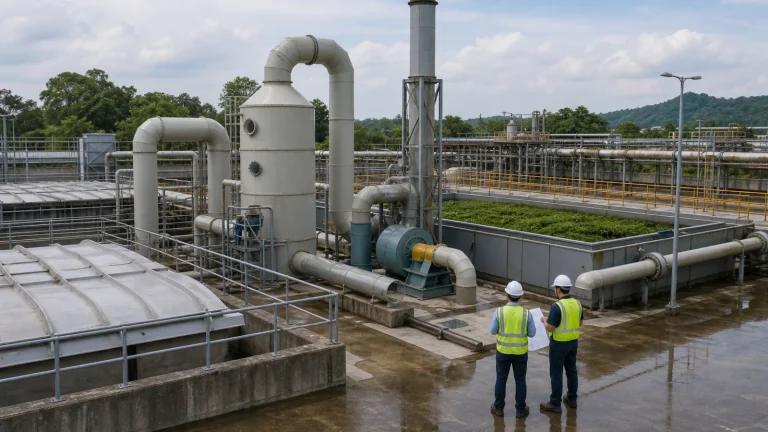
Why Wastewater Odor Control Fails
Odor systems often fail because they are added after the process layout is already fixed. A tank is covered without enough access. Ductwork is routed with low points that collect condensate. A fan is selected without considering pressure loss through dampers, long ducts, scrubber packing, biofilter media, and future fouling. A scrubber is installed without reliable chemical dosing or blowdown. A biofilter is oversized on paper but receives air that is too dry, too hot, too acidic, or too variable.
The strongest design principle is simple: capture odor as close to the source as practical, move it through a controlled ventilation path, treat it with technology suited to the gas composition, and give operators enough access and instruments to keep the system stable.
1. Identify the Real Odor Sources
A good odor-control study starts with source identification, not equipment selection. Industrial wastewater facilities can release odors from collection sumps, screens, grit chambers, equalization tanks, neutralization tanks, DAF units, biological tanks, anaerobic reactors, sludge thickeners, sludge holding tanks, dewatering machines, cake bins, chemical storage, and truck loading areas.
Different sources have different odor chemistry. Septic wastewater and sludge may release hydrogen sulfide and reduced sulfur compounds. Food, beverage, rendering, pulp, chemical, or petrochemical wastewater may include volatile organic compounds or fatty acids. High-pH streams may release ammonia. Chemical reaction areas may release acid or caustic fumes. The treatment system should be selected for the actual gas stream rather than a generic odor label.
2. Control Retention Time and Septic Conditions
Odor control starts inside the liquid process. Long retention time, stagnant zones, settled sludge, warm wastewater, low dissolved oxygen, sulfate-rich wastewater, and anaerobic sludge storage can increase odor generation. If the process design creates septic conditions, the air treatment system must work harder and may still struggle during peak events.
For example, an industrial wastewater equalization tank should be reviewed for mixing, turnover, solids settlement, surface scum, temperature, and holding time. Covers and exhaust treatment may be necessary, but they should not replace basic process control. Reducing odor formation at the liquid source is usually more reliable than only treating a stronger exhaust stream later.
3. Decide What Should Be Covered
Covers can be fixed covers, removable modular covers, floating covers, aluminum covers, FRP covers, concrete covers, fabric covers, or partial hoods depending on the unit and access requirements. The decision should consider corrosion, wind load, snow or rain load where relevant, chemical exposure, worker access, inspection openings, mixer removal, foam control, and confined-space entry procedures.
Open channels and tanks are easy to inspect but difficult to control. Fully enclosed units can capture odor more effectively, but they require access planning, negative pressure control, safe ventilation, and maintenance procedures. A cover that cannot be opened safely or resealed properly will create long-term operating problems.
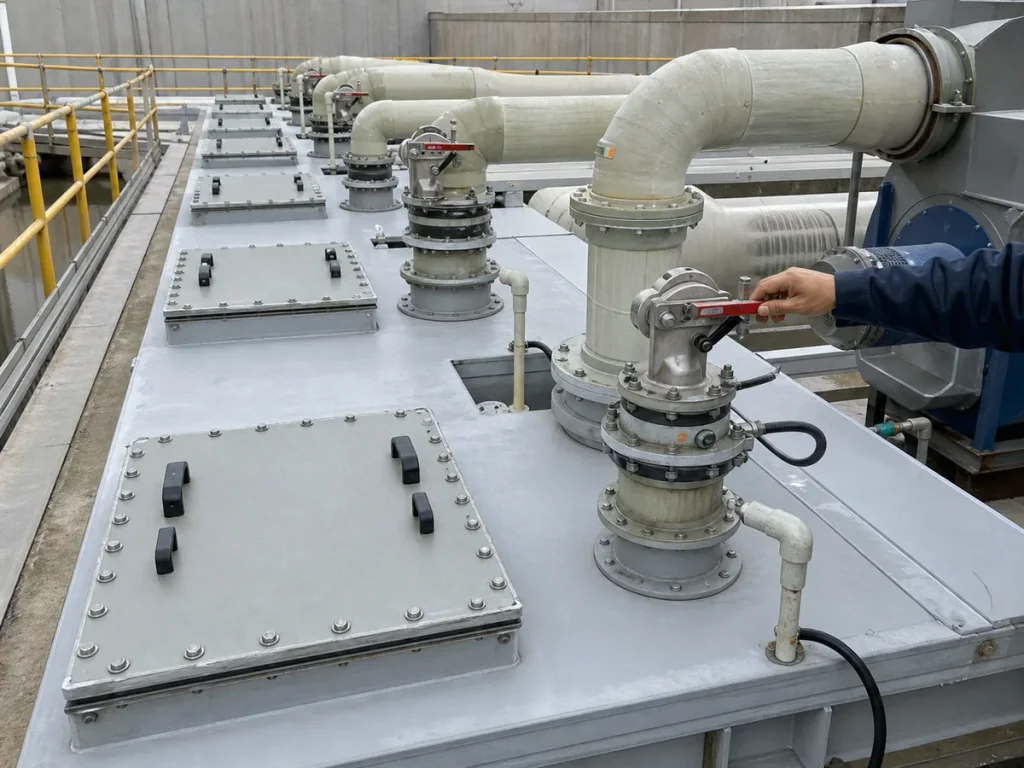
4. Ventilation Rate Must Balance Capture and Treatment Load
Ventilation rate determines whether odor is captured, but more air is not always better. Too little airflow allows leakage from covers, hatches, and doors. Too much airflow increases fan energy, duct size, scrubber size, chemical consumption, biofilter loading, mist carryover, and noise. The correct airflow depends on enclosure volume, leakage paths, source strength, access frequency, gas hazards, and treatment equipment limits.
In many wastewater odor applications, the design goal is controlled negative pressure rather than high air changes alone. Dampers, balancing points, pressure taps, fan turndown, and commissioning measurements are important because field airflow often differs from calculation if the duct network is not balanced.
5. Ductwork Needs Corrosion and Condensate Planning
Odor-control ductwork is exposed to humid, corrosive, and sometimes chemically aggressive air. FRP, PVC, stainless steel, coated steel, or other materials may be selected depending on gas composition, temperature, UV exposure, structural support, fire requirements, and local codes. The duct system should avoid unnecessary low points, dead legs, and inaccessible dampers.
Condensate is a common source of trouble. Warm saturated air can cool inside ducts, forming acidic condensate that attacks fittings, blocks low points, damages fans, or drains back into units unpredictably. The design should include slope, drain legs, traps, cleanouts, isolation, and safe return or disposal of condensate.
6. Select Treatment Technology From Gas Composition
Common odor treatment options include chemical scrubbers, biological scrubbers, biofilters, activated carbon, hybrid systems, mist eliminators, and in some cases thermal or catalytic systems for specific industrial VOC streams. Each option has a different operating envelope.
Chemical scrubbers can be effective for soluble and reactive compounds such as hydrogen sulfide, ammonia, or acidic gases when pH, oxidation-reduction potential, recirculation rate, chemical feed, packing condition, and blowdown are controlled. Biofilters can be effective for biodegradable odor compounds when humidity, temperature, nutrient balance, pH, media condition, and loading rate are suitable. Activated carbon can work well as polishing or for intermittent low-flow sources, but media life and breakthrough monitoring must be planned.
Hybrid designs are common when one technology alone is not ideal. A packed-bed scrubber may reduce high hydrogen sulfide before a biofilter or carbon polishing stage. A mist eliminator may protect downstream media. A pre-humidifier may help a biofilter. The design should match the source profile instead of forcing every odor problem into one equipment type.
7. Sludge Handling Areas Deserve Special Attention
Sludge storage, thickening, dewatering, and cake handling often produce concentrated odor because solids are retained, warmed, sheared, mixed with polymer, and exposed during discharge. A well-designed industrial wastewater sludge dewatering system should therefore review odor capture around sludge tanks, feed pumps, dewatering equipment, filtrate drains, conveyors, bins, and truck loading.
Local hoods and enclosed conveyors may be more practical than ventilating a whole room at high flow. Cake bins may need covers, dedicated exhaust, or scheduled removal before anaerobic odor becomes severe. Floor drains and filtrate channels should not become uncontrolled odor sources.
8. Safety Requirements Are Part of the Odor System
Hydrogen sulfide is both an odor compound and a safety hazard. It can be dangerous at concentrations far above the level where people first detect odor, and odor perception is not a reliable safety instrument. Oxygen deficiency, explosive gas risk, chemical exposure from scrubber reagents, confined-space entry, and fan isolation procedures also need attention.
Projects involving anaerobic reactors, digesters, or covered sludge systems should coordinate odor control with gas safety. The same site may include biogas handling and desulfurization equipment, but odor exhaust should not be casually connected to fuel gas systems, flare systems, or building ventilation without a clear hazard review.
9. Scrubber Design Checks
A packed-bed chemical scrubber should be reviewed for inlet concentration, target outlet concentration, airflow, gas temperature, humidity, pressure drop, packing depth, liquid distribution, recirculation rate, chemical dosing, pH control, ORP control where oxidation is used, mist elimination, blowdown, access, corrosion, and freeze protection where relevant.
Operators need safe chemical storage, containment, dosing pump access, calibration points, sample ports, and clear alarm logic. A scrubber without stable chemical feed can quickly become an expensive fan and vessel. Blowdown handling should also be defined because spent scrubber liquid may contain sulfates, salts, organics, oxidants, or pH extremes.
10. Biofilter and Biological System Checks
Biofilters rely on living microorganisms and suitable media conditions. The design should check loading rate, media depth, residence time, moisture, nutrient availability, pH, temperature, pressure drop, irrigation, drainage, bypass, and media replacement access. Air that is too dry can reduce biological activity. Air that is too acidic or too high in sulfide can damage performance if not buffered or pretreated.
Biofilters are not maintenance-free. Media can settle, compact, dry out, channel, or develop high pressure loss. Access for inspection, irrigation, drainage, and media removal should be designed into the layout from the start.
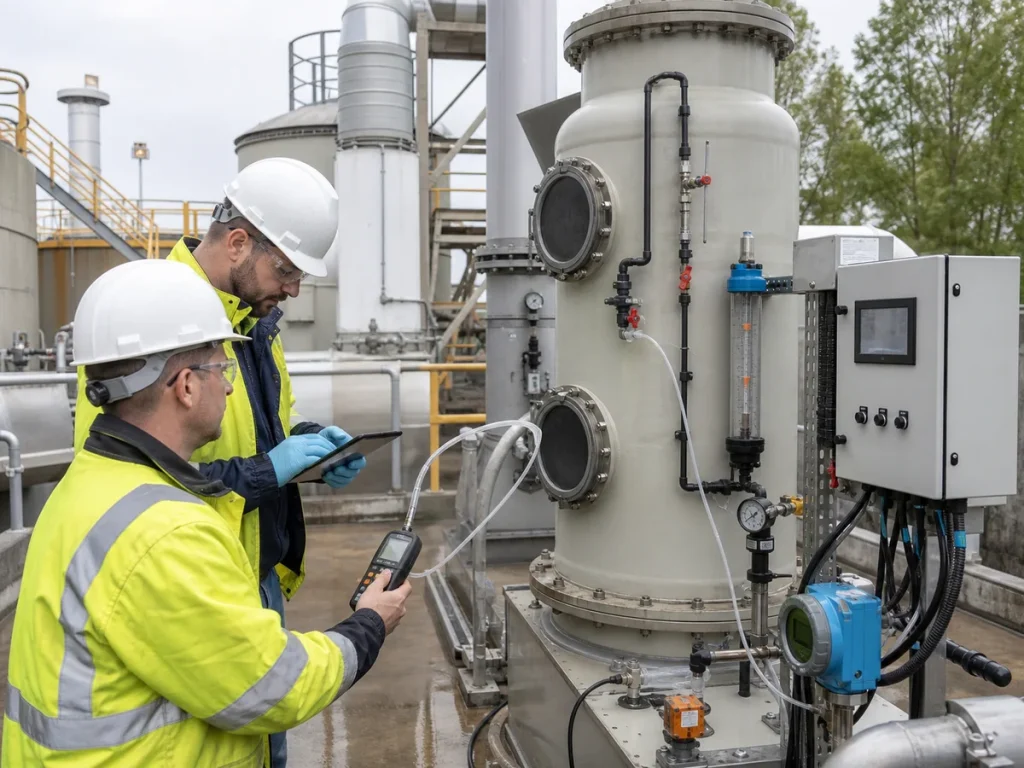
11. Instrumentation and Monitoring
Useful instruments may include airflow measurement, fan speed, duct static pressure, scrubber pressure drop, recirculation flow, pH, ORP, conductivity, sump level, chemical tank level, blowdown flow, biofilter pressure drop, humidity, temperature, H2S monitoring, VOC monitoring, and stack sampling ports. Not every plant needs every instrument, but the system must provide enough information to detect performance drift before complaints or safety alarms occur.
Portable field measurements are also valuable during commissioning. Smoke testing, pressure readings, airflow balancing, H2S spot checks, VOC readings, outlet sampling, fan curve verification, and visual inspection of leaks can reveal problems that are invisible from the control panel.
12. EPC Layout and Maintenance Access
Odor-control equipment competes for space with tanks, pipe racks, blowers, chemical skids, electrical panels, roads, cranes, and maintenance zones. The layout should provide access to fan motors, scrubber packing, nozzles, pumps, dampers, drain points, instruments, biofilter media, carbon vessels, and sample ports. Replacement of media or packing should be possible without major demolition.
Noise, vibration, stack height, exhaust direction, chemical delivery routes, drainage, weather protection, and electrical classification should also be reviewed. A system that performs technically but cannot be maintained safely will not stay effective.
Odor Control EPC Checklist
- List all odor sources and classify likely compounds such as hydrogen sulfide, ammonia, VOCs, fatty acids, or chemical fumes.
- Reduce odor generation through mixing, turnover, solids control, sludge age control, and septic-condition prevention where possible.
- Select covers or hoods that capture odor while preserving inspection, cleaning, and equipment removal access.
- Balance ventilation rate for negative pressure, worker safety, treatment capacity, and energy use.
- Design ductwork for corrosion resistance, condensate drainage, balancing, isolation, and cleanout access.
- Choose scrubber, biofilter, carbon, or hybrid treatment based on gas composition and variability.
- Coordinate odor capture around sludge handling, cake storage, filtrate drains, and truck loading.
- Include safety review for hydrogen sulfide, confined spaces, oxygen deficiency, chemical dosing, and explosive gas risk.
- Provide instrumentation and sampling points for airflow, pressure loss, chemical control, H2S, VOCs, and maintenance diagnostics.
- Commission the full system with field airflow balancing, leak checks, outlet monitoring, alarm testing, and operator training.
Conclusion
Industrial wastewater odor control is most reliable when it is designed into the plant, not attached after complaints begin. Covers, ventilation, ductwork, fans, scrubbers, biofilters, carbon polishing, safety controls, drainage, access, and monitoring all affect final performance.
For EPC projects, the best result usually comes from combining source control with well-balanced air capture and treatment equipment selected for the actual odor chemistry. That approach reduces nuisance risk, improves operator safety, protects equipment from corrosion, and makes the wastewater facility easier to operate over its full service life.