
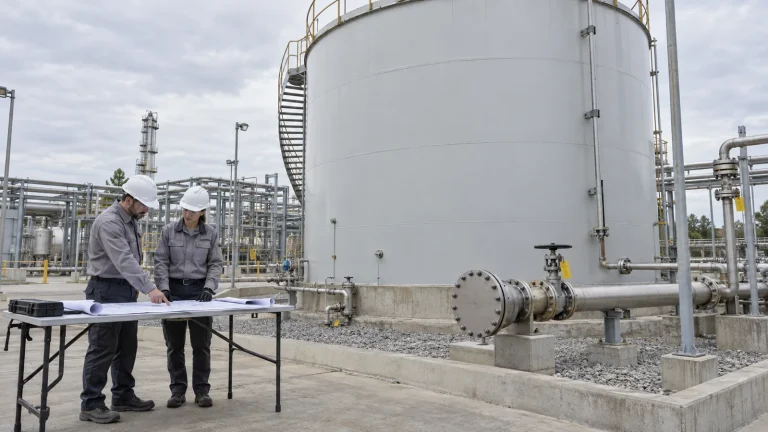
Reusing an existing storage tank for a different product can appear straightforward: empty it, clean it and update the label. That sequence misses the central engineering question. The tank was designed, equipped, inspected and operated for a particular duty; a new liquid can change structural loading, corrosion mechanisms, vapor behavior, contamination risk and the suitability of every wetted component.
This guide explains the owner-side review for changing the service of an industrial aboveground storage tank. It is intended to organize the decision and the evidence needed before recommissioning. It does not certify a tank for a new product or replace the governing design standard, competent engineering assessment, manufacturer requirements or local regulation.
Start With a Written Old-Duty and New-Duty Basis
A product name is not an adequate design basis. Record the previous material, the proposed material and the credible range of composition, concentration, contaminants, temperature and operating conditions for each. Include density or specific gravity, vapor pressure, flash point where relevant, viscosity, freezing or crystallization behavior, water sensitivity, toxicity, corrosivity and any tendency to polymerize, form deposits or degrade during storage.
Then define the operating envelope: normal and maximum fill level, receipt and withdrawal rate, minimum and maximum temperature, expected residence time, mixing or heating, nitrogen blanketing where used, recirculation, cleaning chemicals, startup batches and abnormal scenarios. A tank acceptable for a mild duty at ambient temperature may not remain acceptable when concentration or temperature changes. Review the actual safety data and supplier information rather than relying on a family name such as “solvent,” “acid” or “diesel.”
API’s published inspector body of knowledge explicitly includes change-of-service effects within suitability-for-continued-service assessment for API 653 tanks. That does not mean every tank or conversion is governed by API 653; it illustrates why the change belongs in an engineering and inspection process rather than only an operations checklist. The applicable standard and edition must be established for the specific tank.
Separate Mechanical Integrity From Chemical Compatibility
Two different questions must both have defensible answers. First, is the tank structurally fit for the proposed loading and operating conditions? Second, are its materials and components compatible with the new stored material over the intended service life? Passing an integrity inspection does not prove chemical compatibility, and a compatibility chart does not prove adequate remaining thickness or foundation condition.
The integrity review should consider original design information, inspection history, repairs, current thickness data, corrosion rates, settlement, distortions, welds, nozzles, roof condition and foundation. If drawings or material records are incomplete, the responsible engineer must decide what verification is necessary and how uncertainty will be managed. A statement such as “the tank previously held a similar product” is not a calculation.
A denser product can increase hydrostatic loading at the same liquid height. A higher operating temperature may affect material properties, allowable limits, corrosion behavior and attached equipment. A lower-temperature duty can raise toughness and brittle-fracture questions. The approved maximum fill height may therefore change even when the tank dimensions do not.
Review Every Wetted and Vapor-Exposed Material
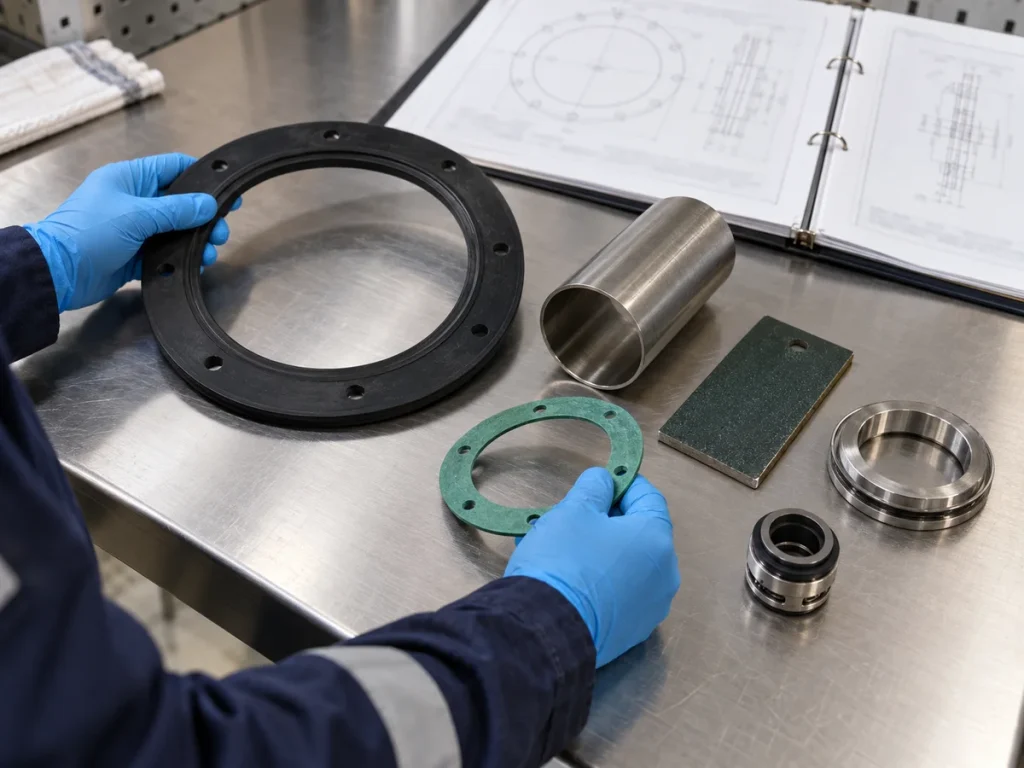
The compatibility review extends beyond the shell and bottom plate. Build a component register covering the internal lining or coating, roof and floor internals, floating suction or mixer parts, heating coils, gaskets, O-rings, valve seats, flexible connectors, pump seals, instrument diaphragms, level probes, sample tubing, hoses, strainers and drain components. Include items in the vapor space because vapor exposure can differ from liquid immersion.
Use written evidence that matches the actual material grade, compound, concentration, temperature and exposure condition. “Rubber gasket” is not a material specification. Likewise, “stainless steel” does not identify the alloy or prove resistance to a particular chemical. Supplier compatibility tables are screening tools; their assumptions and test conditions need to match the proposed duty, and critical decisions may require manufacturer confirmation or specialist testing.
Begin with the existing tank material selection basis, then verify what was actually installed and what condition it is in. A lining compatible when new may no longer be reliable if it is blistered, cracked, poorly bonded or beyond its qualified service conditions.
Define “Clean Enough” for the Next Product
Cleaning acceptance should be based on the hazards and quality requirements of the next service, not on visual appearance alone. Residual product can create an incompatible reaction, contaminate a high-purity batch, alter color or odor, poison a downstream catalyst, affect fuel quality or prevent a new lining from bonding. Sediment and liquid trapped behind internals, in sumps, dead legs, floating suction assemblies and connected piping need explicit consideration.
Prepare a residue inventory before work starts. Identify the old product, deposits, water bottoms, cleaning agents, rinse liquid, removed scale and any materials that may be pyrophoric, reactive or hazardous when exposed. The work package should define isolation, atmosphere control, entry requirements where applicable, waste routing and the verification method. The detailed execution belongs in the site’s tank cleaning and turnaround plan.
Verification may involve inspection, targeted swabs, rinse sampling, laboratory analysis or product-specific acceptance tests. The correct method depends on what must be excluded and where it may remain. One sample from a convenient drain cannot demonstrate that every internal pocket or connected line is clean. Record sample locations and detection limits so a result is not given more meaning than the method supports.
Recalculate Venting and Vapor Management
A new product can change normal breathing, filling and withdrawal loads, vapor generation, emissions, condensation, blanketing demand and emergency scenarios. Review the complete vapor path: conservation vent or pressure-vacuum vent, emergency venting, flame arrester where applicable, vapor-recovery line, knockout equipment, inert-gas controls and discharge location. Confirm material compatibility as well as capacity and set points.
Do not assume that an existing vent is adequate because its connection size has not changed. Capacity depends on the duty and the system configuration, including restrictions introduced by piping, valves, arresters or fouling. A more volatile product may also change hazardous-area classification and emissions obligations. Conversely, a product prone to solidification or deposits can impair a vent without having high vapor pressure.
The engineering review should be coordinated with the site’s vapor recovery and pressure-control arrangements. Any change to vent settings must remain consistent with the tank’s allowable pressure and vacuum. A storage tank must not be treated as a pressure vessel simply by tightening its vents.
Check Instruments, Alarms and Operating Limits
Instrument suitability is both mechanical and functional. Review wetted materials, temperature and pressure ratings, hazardous-area certification, measurement principle and calibration basis. Density, dielectric properties, conductivity, viscosity, foam, vapor and buildup can affect different level technologies in different ways. A gauge that produces a plausible number is not necessarily measuring the new product correctly.
Reconfirm the tank strapping or capacity table assumptions, working capacity, high and high-high alarm levels, independent overfill protection, low-level protection, pump permissives and shutdown actions. If maximum fill height is reduced by the engineering assessment, the alarm and inventory systems must reflect the new limit. Where a differential-pressure measurement is used, density assumptions deserve particular attention.
Temperature sensors, water-interface detection, leak detection, gas detection and sampling arrangements may also need revision. Proof testing should demonstrate the complete protective function, including the final element and operator response, rather than only checking that a display changes.
Extend the Review Beyond the Tank Shell
A change of service crosses discipline boundaries. Trace the new product from delivery connection to tank and from tank to its users. Review transfer piping, pumps, seals, filters, meters, hoses, loading arms, drains, closed-drain systems and any shared manifold where cross-contamination is possible. Confirm that line identification and valve lineups match the as-built arrangement.
Reassess secondary containment, drainage, spill response, firefighting strategy and emergency equipment for the new material. A bund sized for the tank may still have incompatible joint sealants or an inappropriate drainage route. Firewater, foam or extinguishing-agent assumptions may change. Environmental permits, inventory reporting, insurance requirements and emergency plans may require updates before receipt of the first delivery.
For a documented example of why component-level compatibility matters, the U.S. Department of Energy’s Alternative Fuels Data Center lists tanks, piping, sumps, pumps, release detection, overfill equipment and other parts when discussing biodiesel blends. Its requirements are specific to that fuel and jurisdictional context, but the engineering lesson is broadly useful: evaluate the whole storage system, not just the vessel material.
Use Management of Change to Control the Interfaces
The change should have a named owner, technical reviewers and explicit approval gates. The package should capture the design basis, compatibility evidence, integrity assessment, required modifications, inspection and test plan, revised drawings, operating procedures, training, permits and pre-startup review. Temporary arrangements and assumptions need owners and closure dates.
HSE guidance for thermoplastic tanks, for example, states that a change of use should be properly managed and considers compatibility, concentration, loading and retained records. The material-specific details of that guidance do not govern steel tanks, but it reinforces the need to preserve the technical basis for a duty change rather than treating the new label as the change record.
Update the tank data sheet, equipment register, piping and instrumentation diagrams, cause-and-effect documentation, hazardous-area information, inspection plan and maintenance strategy. Future inspectors need to know when the new service began, what limits were approved and which materials were replaced.
Plan a Controlled First Fill and Recommissioning
Before introducing product, confirm that construction and cleaning punch items are closed, isolation has been restored correctly, temporary equipment is removed, drains and vents are in their operating configuration, instruments are calibrated, alarms and trips are tested, and emergency arrangements are available. Verify that the correct product and delivery line have been positively identified.
The startup plan should define an initial fill quantity or level, hold points, leak inspection, vent and blanketing checks, sampling locations, laboratory tests where needed and the authority to proceed. Monitor seals, nozzles, drains, pumps, level response, pressure or vacuum behavior and containment. A successful leak check alone does not establish product quality or material compatibility.
Set early follow-up inspections based on the credible degradation mechanisms of the new duty. These may include lining condition, gasket leakage, filter loading, corrosion monitoring, water or sediment, instrument fouling and product quality. The interval must come from the engineering assessment and operating evidence, not from a universal calendar rule.
Minimum Decision Record
- Old and new duty envelopes, including credible composition, concentration, density and temperature.
- Applicable design, inspection, environmental and fire-safety requirements.
- Integrity assessment and any revised maximum fill height or operating limit.
- Compatibility register for tank, lining, internals, seals, valves, piping and instruments.
- Cleaning acceptance basis, residue verification and waste-disposal evidence.
- Venting, vapor control, hazardous-area, containment and emergency-response review.
- Modified drawings, procedures, alarm set points, training and pre-startup approvals.
- First-fill results, sample records, deviations and scheduled follow-up checks.
Bottom line: a tank change of service is a new engineering duty assigned to an existing asset. The defensible route is to define that duty, verify structural fitness and component compatibility, remove residues to a product-specific acceptance basis, revalidate safeguards and recommission under controlled conditions. If any of those links is missing, changing the tank label does not complete the conversion.