
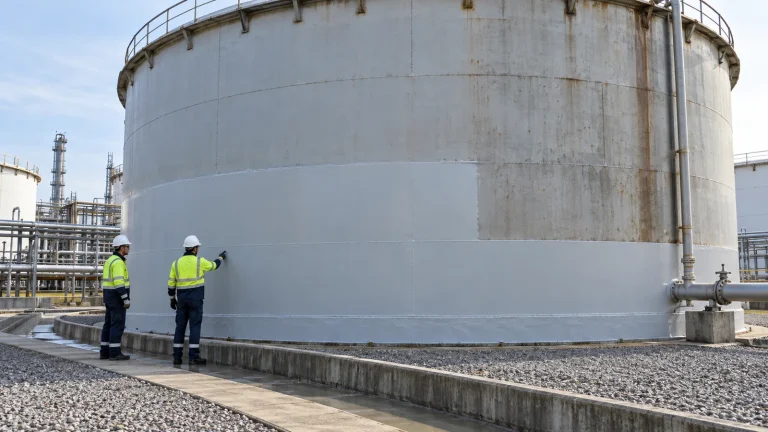
An aboveground steel tank can look sound from the road while corrosion is developing at its lower shell, roof edge, nozzles, handrail attachments or places where water remains trapped. Exterior coating is therefore more than a color choice. It is a specified barrier system whose performance depends on the exposure, steel condition, surface preparation, application and future access. This guide is for the atmosphere-exposed outside surfaces of industrial storage tanks; it does not cover product-wetted linings or the underside of a tank bottom.
Start with the actual exposure, not a generic paint schedule
Record whether the tank sits in a coastal, industrial, humid or relatively dry environment, and whether parts of the shell see chemical mist, washdown, condensation, standing water or repeated contact with insulation. The site-wide corrosivity category is a starting point, not a guarantee that every point on the tank has the same exposure. Roof penetrations, seams and sheltered details may form local micro-environments. ISO 12944-2 provides the environmental classification framework for protective paint systems on steel structures.
Separate the atmospheric shell and roof coating specification from any internal tank lining. The latter has to withstand direct contact with the stored liquid, cleaning chemicals and operating temperature; an exterior system selected for rain and sunlight cannot simply be reused inside. Also flag heated or insulated tanks early: damage hidden beneath insulation needs a different inspection and coating strategy, as discussed in our guide to tank heating and insulation.
Make the tank paintable and inspectable
Before selecting a coating, walk the tank and mark the vulnerable details. Look at the shell-to-bottom region, roof-to-shell junction, nozzle reinforcement, welded attachments, platform brackets, anchor-chair geometry and pipe supports close to the tank. Identify where water drains and where it is retained. A specification cannot overcome a detail that continuously traps moisture or prevents the applicator from reaching the steel.
For a new tank, coordinate edge treatment, weld finishing, clearance behind attachments and safe maintenance access with the fabricator. For an existing tank, distinguish corrosion staining from actual section loss or cracking. Coating contractors should not paint over a structural concern; the owner needs an engineering disposition first. A coating survey also needs to map old coating type, remaining adhesion, previous repairs and any hazardous legacy coating before abrasive or power-tool removal.
Specify the surface before specifying the paint
Surface preparation is a system decision. The contractor and coating manufacturer must agree how much existing paint can remain, whether spot or full abrasive blasting is appropriate, and how to prepare welds, edges and inaccessible locations. ISO 12944-4 addresses surface types and preparation; ISO 8501-1 provides visual rust and preparation grades. The required grade and surface profile should be stated in the job specification, not assumed from the coating product name.
Remove oil and grease before blasting, manage abrasive dust, and check for contamination where marine salts, process deposits or wash water are plausible. Water-soluble salts can remain after a surface looks clean. The ISO 8502-6 Bresle method describes field extraction of soluble contaminants for analysis; it does not by itself set a universal acceptance limit. Define the test locations, method and project limit with the selected coating manufacturer and owner. Record the achieved profile and cleanliness before primer application, especially around weld toes and lower-shell areas.
Choose a compatible system and define its boundaries
A coating schedule should state each layer, compatible product, nominal and permitted dry-film-thickness range, surface preparation, stripe-coat requirements, recoat window, curing conditions and repair method. ISO 12944-5 describes protective paint systems and links selection to environment, preparation and durability; it is not a substitute for the product data sheets and a project-specific specification. Typical systems may combine a corrosion-resistant primer with intermediate and UV-resistant finish coats, but material families and layer counts should be selected for this tank’s exposure, substrate and maintenance window.
State precisely where the scope begins and ends: external shell, roof, stairs, nozzles, appurtenances and associated structural steel may need different preparation or products. Check compatibility with existing sound coating for partial repairs, and with galvanized or stainless parts if they are included. Hot surfaces need a temperature-rated system; a normal atmospheric coating may not be suitable. Do not treat the coating durability classification as a warranty or as a prediction of time to structural failure.
Control the application conditions and hold points
At the workface, record air temperature, relative humidity, steel surface temperature and dew point at the frequency required by the specification and product data sheet. Painting a surface that is damp or likely to condense is a preventable failure mode. ISO 8502-4 provides guidance on estimating condensation probability before painting. Avoid a universal dew-point margin or humidity limit in a generic article: the approved procedure and manufacturer data govern each product and site.
Define hold points before work starts: substrate condition and cleaning; blasting and soluble-salt checks where applicable; primer and stripe coating; each successive coat; final appearance and dry-film-thickness survey; cure and handover. Stripe coating targets welds, edges and difficult details that may receive less film in a broad spray pass. Check mixing, pot life, thinner use, recoat interval and cure against the manufacturer’s instructions. ISO 12944-7 addresses execution and supervision of paint work.
Measure quality, not just visual uniformity
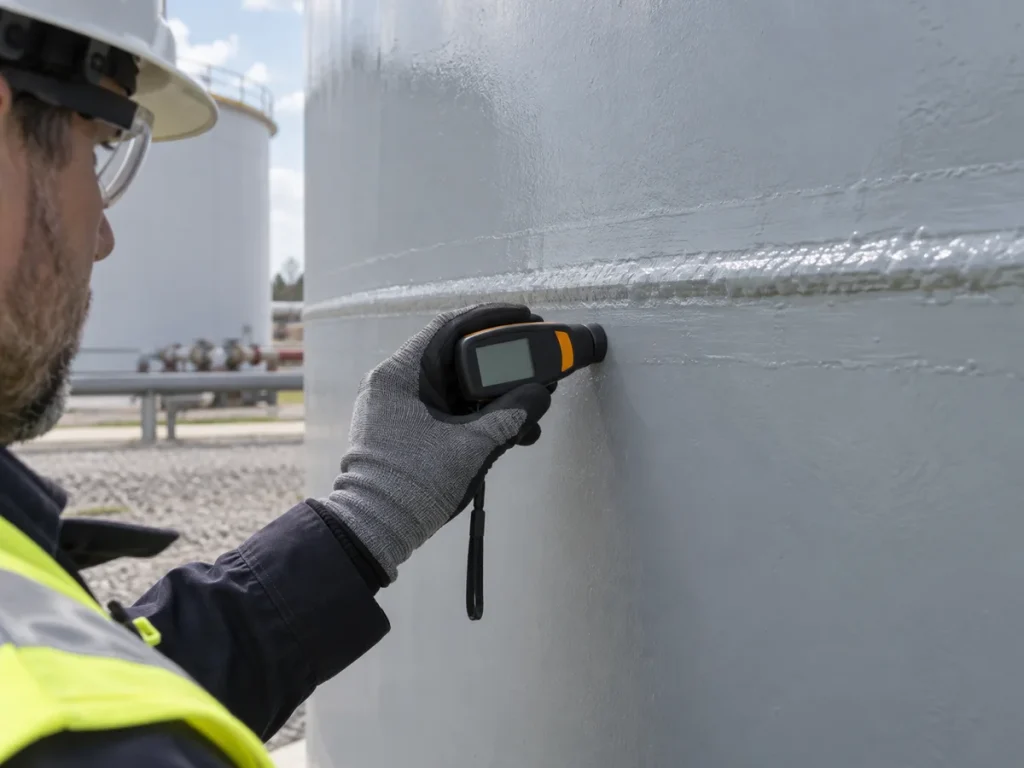
Final inspection should document defects such as pinholes, runs, dry spray, overspray, missed areas and damaged surfaces, with repairs completed before acceptance. Dry-film thickness (DFT) is measured using an appropriate calibrated gauge and sampling plan, not one convenient reading. AMPP SSPC-PA 2 describes a procedure for assessing conformance to a specified DFT range. The target range comes from the approved coating system; too little film can compromise protection, while excessive film can also create application or curing problems.
Adhesion tests or holiday detection should only be specified where appropriate to the coating and service. A holiday test commonly associated with immersion linings is not automatically a useful acceptance test for every exterior paint film. The inspection and test plan should distinguish required tests from optional diagnostics and define how nonconforming areas are prepared, recoated and reinspected.
Plan repairs and retain an auditable record
During service, inspect the lower shell, roof details, joints and attachments for coating breakdown, corrosion creep, mechanical damage and water retention. Photograph and map defects so the next inspection can determine whether deterioration is isolated or spreading. A local touch-up is reasonable only after the substrate and surrounding coating are assessed; recurring failure at the same point may indicate a design or drainage issue. Integrate coating observations with the tank’s wider inspection and maintenance program rather than treating paint as a standalone cosmetic task.
At handover, keep the coating specification and product batch numbers, application dates, weather records, surface-preparation results, stripe-coat confirmation, DFT maps, repair records and as-built photographs. These records make future spot repairs and failure investigations more reliable. Coating work may involve abrasive-blasting hazards, hazardous dust, solvents, work at height and an operating tank farm; the owner and contractor must apply site-specific permits, isolation, containment and competent-person controls.
EPC checklist
- Classify exposure and document local conditions at roof, shell, attachments and low points.
- Confirm steel condition and decide whether engineering repair is needed before painting.
- Specify preparation grade, profile, contamination testing, hold points and compatible products.
- Define stripe coating, each coat’s DFT range, application limits and repair method.
- Verify safe access, inspection records and a maintainable future survey route.
Bottom line: a durable exterior coating is the outcome of a controlled engineering and QA process, not a paint brand alone. Treat local exposure, substrate preparation, application and future inspection as one scope of work.