
Internal coatings and linings are often the difference between a storage tank that reaches its design life and a tank that needs early repair. Steel may provide the structural strength, but the lining system is what separates that steel from water, wastewater, chemicals, oils, slurries, acids, alkalis, salts, solvents, or other stored liquids. If the lining is selected or applied poorly, corrosion can begin long before the owner expects a maintenance outage.
For EPC teams, tank lining work should not be treated as a finish coat at the end of construction. It is a process that starts with chemical compatibility and continues through surface preparation, environmental control, stripe coating, application sequence, dry film thickness, curing, holiday testing, repair, commissioning, and long-term inspection planning.
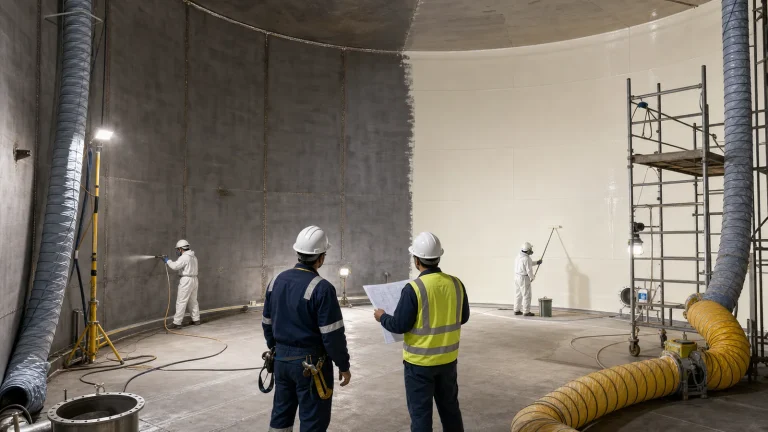
What Internal Coatings and Linings Are Expected to Do
An internal coating or lining provides a barrier between the stored product and the tank substrate. In a carbon steel tank, the lining may prevent general corrosion, under-deposit corrosion, pitting, chemical attack, product contamination, or coating undercutting at defects. In some projects, the lining also makes cleaning easier, improves product purity, or reduces corrosion at weld seams and floor-to-shell corners.
The lining is not a substitute for correct tank design. If the stored liquid is too aggressive, if the temperature is outside the coating envelope, if abrasion is severe, or if cleaning chemicals are incompatible, the lining may fail even when it was applied correctly. Lining selection should therefore happen alongside tank material selection, not after the tank has already been procured.
1. Start With Chemical Compatibility
The first design question is simple: what will the lining touch during normal operation, abnormal operation, cleaning, and maintenance? The answer should include stored liquid concentration, pH, chlorides, solvents, oxidizers, oils, temperature, immersion time, vapor phase exposure, sludge deposits, biological activity, and cleaning agents. A lining that performs well in neutral water may fail rapidly in hot caustic, acidic condensate, solvent-containing wastewater, or abrasive slurry.
Compatibility should be confirmed with manufacturer data, project history, and where needed immersion testing or service references. EPC specifications should avoid vague phrases such as “chemical resistant coating” without defining the actual liquid, temperature, exposure, and acceptance criteria.
2. Separate Immersion, Splash and Vapor Zones
Inside a storage tank, exposure is not always uniform. The floor may see sludge, settlement, under-deposit corrosion, and mechanical cleaning. The lower shell may stay immersed. The upper shell may see vapor, condensation, oxygen, and intermittent wetting. The roof underside may experience condensate, chemical vapor, or temperature cycling. These zones can require different coating thickness, stripe coating, or even different coating systems.
If the tank cycles between empty and full, the wet-dry interface can become a high-risk corrosion area. Tanks storing wastewater, brine, chemicals, or process liquids may also develop aggressive deposits at the floor, shell corner, nozzles, and roof underside. The lining specification should identify these zones explicitly.
3. Surface Preparation Controls Lining Life
Most lining failures begin before the coating is sprayed. Poor abrasive blasting, remaining mill scale, soluble salts, dust, oil contamination, excessive profile, insufficient profile, high humidity, condensation, or delayed coating after blasting can compromise adhesion. Weld spatter, sharp edges, laminations, pits, and rough welds can also create weak points where the coating thins or holidays form.
Surface preparation should define cleanliness standard, anchor profile range, abrasive type, compressed air quality, salt limits where applicable, dust acceptance, edge grinding, weld dressing, inspection hold points, and maximum time between blasting and coating. Ambient conditions should be monitored for steel temperature, dew point, relative humidity, and ventilation.
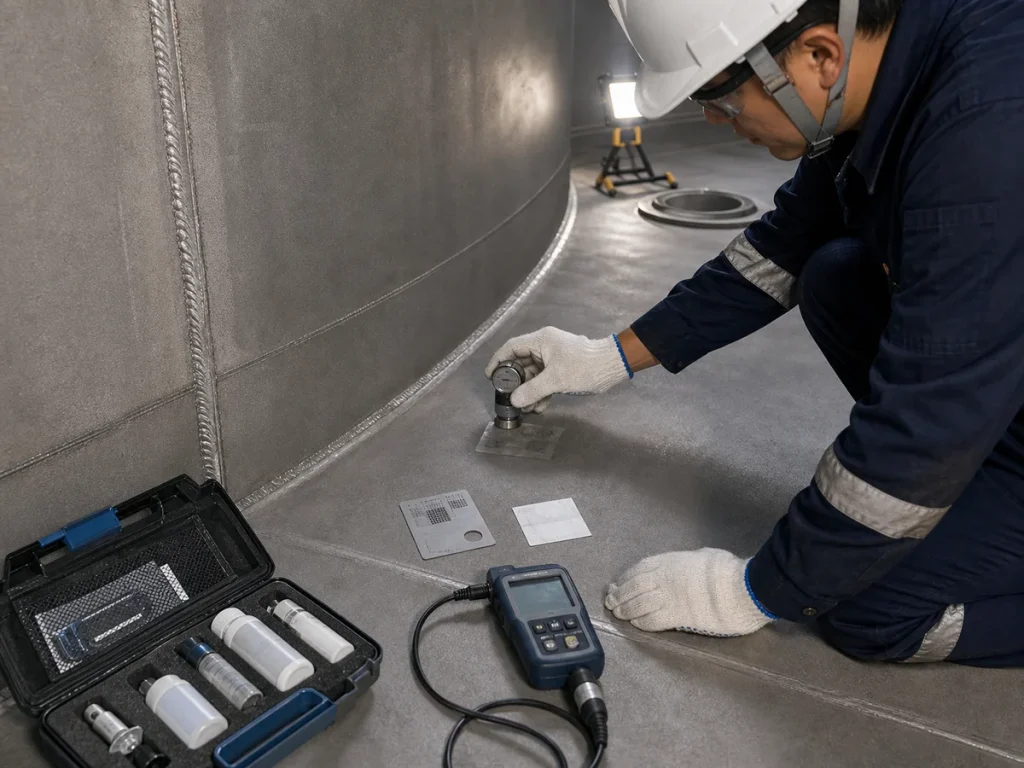
4. Welds, Corners and Nozzles Need Extra Attention
Coatings naturally thin at sharp edges, weld toes, bolt heads, corners, and complex geometry. The floor-to-shell corner, lap joints, annular plates, nozzle necks, manways, sumps, internal piping supports, mixer brackets, and roof penetrations are common failure points. Stripe coating is used to build coverage over these difficult areas before full spray application.
In a field-welded tank, weld quality and surface preparation are closely connected. In a bolted or factory-coated tank, joint details, gasket compression, panel edges, and field touch-up areas become equally important. This is why construction method decisions, such as the comparison between bolted steel tanks and welded steel tanks, should include lining repair and field coating requirements.
5. Choose the Right Lining Type
Common tank lining systems include epoxy, phenolic epoxy, novolac epoxy, vinyl ester, polyurethane, polyurea, rubber lining, glass flake systems, cementitious linings, and specialty fluoropolymer or thermoplastic systems for demanding chemical services. Each has limits for temperature, chemical resistance, flexibility, abrasion, cure time, application method, repairability, and cost.
Epoxy systems are widely used for water, wastewater, and many industrial liquids. Novolac or glass flake systems may be selected for more aggressive chemical or higher temperature service. Rubber linings may fit certain acid, alkali, or abrasion cases but require skilled application and careful spark testing. Cementitious linings may fit potable water or concrete tank rehabilitation in certain projects, but they are not the same decision as a high-build polymer lining.
6. Thickness Is Important, but More Is Not Always Better
Dry film thickness is one of the easiest values to measure, but it is not the only quality indicator. Too little thickness can leave holidays, weak barrier protection, or premature corrosion. Too much thickness can cause solvent retention, cracking, sagging, poor cure, internal stress, or longer return-to-service time. The correct thickness depends on product chemistry, lining type, application method, and manufacturer instructions.
The inspection plan should define minimum, maximum, average, and local spot thickness acceptance where applicable. Measurements should be taken across floors, shell courses, weld areas, nozzles, repaired zones, and difficult geometry. Records should show where readings were taken, not just an average value for the tank.
7. Environmental Control During Application
Tank lining work happens inside a confined steel structure where temperature, humidity, airflow, solvent concentration, dust, and lighting can change quickly. Ventilation is required for worker safety and for coating cure, but excessive or poorly directed airflow can also introduce dust or create uneven drying. Dehumidification may be needed in humid climates or during night work.
Steel temperature should remain above the dew point by a safe margin before and during coating. Condensation on blasted steel can be enough to cause early failure. Application should also avoid coating over dust, spent abrasive, unremoved masking residue, or contaminated footwear tracks.
8. Cure and Recoat Windows Matter
A lining can look finished before it is chemically ready for service. Cure depends on coating chemistry, temperature, ventilation, film thickness, humidity, and time. Returning a tank to service too early can cause soft film, blistering, chemical attack, discoloration, or loss of adhesion. Waiting too long between coats can also create intercoat adhesion problems if the recoat window is exceeded.
The EPC schedule should include realistic coating cure time and inspection time before hydrotest or product filling. If the project compresses this window at the end of construction, lining quality often becomes the hidden casualty.
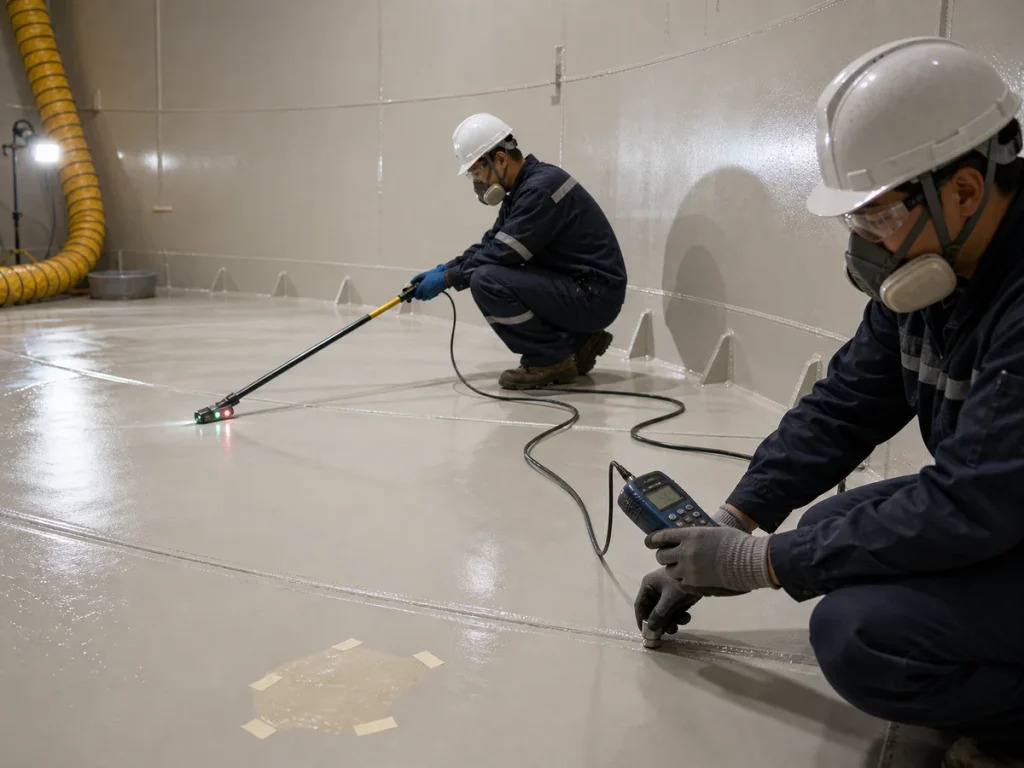
9. Holiday Testing and Final Inspection
Holiday testing checks for pinholes, voids, thin areas, or discontinuities in a nonconductive lining over a conductive substrate. The test method and voltage should match coating thickness and project requirements. Too low a setting may miss defects; too high a setting can damage the coating. Testing should be performed after adequate cure and before the tank is placed into service.
Final inspection may also include visual inspection, dry film thickness readings, adhesion testing where specified, cure checks, solvent rub tests, spark testing for rubber linings, repair verification, cleanliness checks, and review of quality records. The goal is not only to pass a checklist. The goal is to confirm that the lining is continuous, cured, compatible, and ready for real service.
10. Repair Procedures Should Be Defined Before Defects Appear
Every lining project should expect some repair. Pinholes, thin areas, mechanical damage, dust inclusions, missed stripe areas, runs, sags, or adhesion issues can occur. The repair procedure should define surface preparation, feathering, cleaning, recoat window, repair material, cure time, retesting, and documentation.
Field repair is especially important around nozzles, ladders, platforms, roof penetrations, manways, mixer supports, and temporary scaffold contact points. A repair that looks acceptable visually may still fail if surface preparation or cure is inadequate.
11. Hydrostatic Testing and Commissioning Interface
Hydrostatic testing can expose lining problems, but it can also damage a lining if timing, water quality, filling rate, drainage, or post-test drying are not managed. Some lining systems should not be immersed before full cure. Some tanks require potable water, dechlorinated water, controlled pH, or prompt drying after test depending on lining and service.
The lining plan should be coordinated with hydrostatic testing and commissioning. EPC teams should define whether the tank is coated before or after hydrotest, how test water will be controlled, how the tank will be drained and dried, and how final inspection will be performed before handover.
12. Common Failure Modes
Common internal lining failures include blistering, disbondment, underfilm corrosion, osmotic blistering, pinhole corrosion, cracking, solvent entrapment, edge breakdown, chemical softening, abrasion wear, holidays at welds, and mechanical damage during maintenance. The visible defect may appear months after startup, but the root cause often traces back to compatibility, surface preparation, application control, cure, or inspection gaps.
Blisters may indicate moisture, soluble salts, osmotic pressure, poor cure, or contamination. Rust staining at welds may indicate holidays or thin film. Peeling may indicate adhesion failure or recoat window issues. Soft coating may indicate chemical incompatibility or incomplete cure. A good failure review looks beyond the symptom and asks what condition allowed the defect to start.
13. Long-Term Inspection and Maintenance
Tank lining maintenance should be planned from day one. Owners should keep coating data sheets, batch numbers, surface preparation records, environmental logs, DFT maps, holiday testing records, repair logs, cure records, and photographs. During future outages, inspectors should compare lining condition against original records and operating history.
Inspection should focus on floor low points, shell-to-floor corners, nozzles, weld seams, vapor zones, roof underside, sludge areas, mixer zones, manways, and previously repaired areas. Cleaning procedures should avoid tools or chemicals that damage the lining. If product service changes, lining compatibility should be reviewed before the tank is reused.
Internal Lining EPC Checklist
- Define stored liquid chemistry, temperature, concentration, cleaning chemicals, vapor exposure, sludge, abrasion, and abnormal cases.
- Select lining type based on service compatibility, immersion exposure, cure requirements, inspection method, and repairability.
- Specify surface cleanliness, blast profile, salt limits, dust limits, edge grinding, weld dressing, and hold points.
- Control ambient conditions: steel temperature, dew point, relative humidity, airflow, dust, lighting, and ventilation.
- Use stripe coating for welds, corners, nozzles, floor-to-shell joints, supports, and other complex geometry.
- Measure dry film thickness across representative zones, including repaired areas and difficult geometry.
- Respect pot life, recoat window, cure time, and return-to-service requirements.
- Perform holiday testing with the correct method and voltage for the lining thickness and system.
- Document repairs, retesting, environmental conditions, material batches, and final acceptance records.
- Coordinate lining work with hydrotest, cleaning, drying, commissioning, and long-term inspection planning.
Common Mistakes to Avoid
The first mistake is choosing a lining from a generic chemical resistance table without confirming the actual stored liquid, temperature, concentration, cleaning method, and exposure zones. The second is treating surface preparation as a contractor preference rather than a controlled engineering requirement. The third is compressing cure and inspection time at the end of the schedule.
Another common mistake is focusing only on the tank shell while ignoring welds, floor corners, nozzles, roof underside, sumps, and supports. Lining failures often begin at geometry that was difficult to blast, stripe coat, inspect, or repair.
Conclusion
Industrial storage tank internal coatings and linings are engineered protection systems, not decorative finishes. Their success depends on matching the lining to the stored liquid, preparing the steel correctly, controlling the application environment, inspecting the work, allowing full cure, and planning maintenance.
For EPC projects, the safest approach is to specify the lining system early and coordinate it with tank material, construction method, nozzles, hydrotest, access, cleaning, and commissioning. When that coordination is done well, the lining protects the tank asset instead of becoming an early failure risk.