
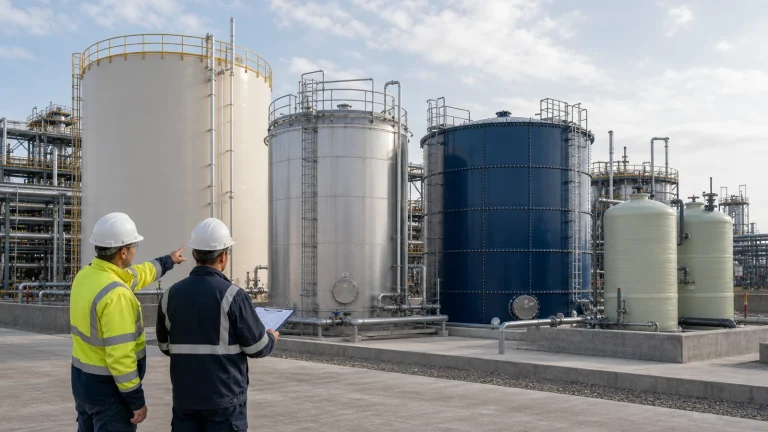
Tank material selection is one of the most important early decisions in an industrial storage project. Carbon steel, stainless steel, FRP, polyethylene, glass-fused-to-steel, bolted coated steel, and concrete can all be correct in the right service. They can also fail early when the stored medium, temperature, cleaning method, foundation, nozzle loads, or maintenance reality is misunderstood.
This article builds on our earlier guide to industrial storage tank selection. Once the project team understands capacity, operating duty, and site conditions, material selection becomes the next major filter. The goal is not to choose the strongest or most expensive material by default, but to choose the tank system that fits the actual service conditions with acceptable lifecycle risk.
Start With the Stored Medium, Not the Tank Catalogue
The first question is not whether carbon steel or stainless steel is better. The first question is what the tank will actually store, how that liquid may change during operation, and what happens during abnormal conditions. A storage tank for clean process water, caustic solution, acidic wastewater, chloride-rich effluent, sludge, digestate, food-grade liquid, fuel, or chemical dosing solution may require very different materials and accessories.
A practical material review should define pH range, chloride content, solids, temperature, density, vapor, biological activity, cleaning chemicals, UV exposure, abrasive particles, and any expected concentration swings. For wastewater projects, the upset condition is often more important than the average condition. Equalization tanks, sludge tanks, chemical dosing tanks, and leachate tanks can see variable chemistry that makes a simple material assumption risky.
Carbon Steel: Flexible and Economical, But Dependent on Protection
Carbon steel is widely used for large industrial storage tanks because it is strong, familiar, readily fabricated, and cost-effective at scale. It can be welded or bolted, shaped for many diameters and heights, and integrated with nozzles, manways, platforms, roof systems, and accessories. For many oils, fuels, process liquids, and non-corrosive services, it can be a practical baseline option.
The main limitation is corrosion. Carbon steel normally needs a suitable coating, lining, cathodic protection strategy, corrosion allowance, or maintenance plan when the stored medium or external environment is aggressive. The wrong coating specification can make a structurally sound tank fail in service. Surface preparation, dry film thickness, curing condition, holiday testing, edge preparation, and repair procedure should therefore be treated as part of the material decision, not as a minor finishing detail.
Stainless Steel: Durable in the Right Grade, Expensive in the Wrong Use
Stainless steel is attractive where hygiene, corrosion resistance, cleanability, or long service life is important. It is common in food, beverage, pharmaceutical, high-purity water, and some chemical applications. It can also be used in industrial wastewater and process systems when the chemistry fits the selected grade.
However, stainless steel is not a single material. Grade selection matters. Chlorides, temperature, crevices, stagnant zones, weld quality, cleaning chemicals, and surface finish can all affect performance. A stainless steel tank can still suffer pitting, crevice corrosion, stress corrosion cracking, or weld-related problems if the grade and fabrication details are not matched to the service.
The project team should also consider galvanic contact, nozzle reinforcement, insulation, external environment, and whether stainless steel is required for the entire tank or only for wetted parts, internals, or specific process components.
FRP and Plastic Tanks: Strong Corrosion Resistance With Mechanical Limits
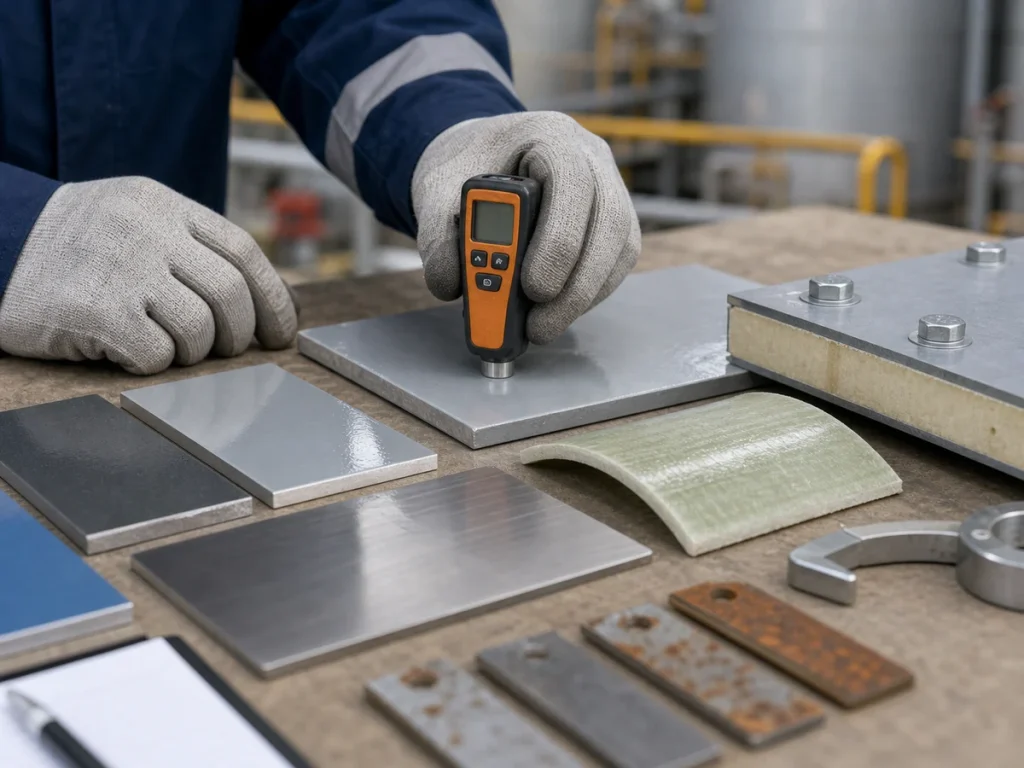
FRP tanks and plastic tanks can be excellent choices for many chemical storage and wastewater treatment duties. They are often used for acids, alkalis, dosing chemicals, scrubber liquids, small to medium process tanks, and corrosive environments where steel protection would be difficult or maintenance-intensive.
The risk is treating FRP or plastic as corrosion-proof without checking the full design basis. Resin selection, laminate structure, UV exposure, temperature, impact risk, vacuum condition, nozzle loads, support method, wind loads, seismic requirements, and long-term creep should be reviewed. FRP tanks may need careful nozzle reinforcement and pipe support because excessive pipe loads can damage the laminate. Plastic tanks can be limited by temperature, chemical compatibility, and mechanical stiffness.
For aggressive chemicals, the vendor should provide a compatibility basis, design temperature, specific gravity limit, venting requirements, installation guidance, and inspection recommendations. In EPC projects, pipe support and flexible connections should be coordinated early.
Glass-Fused-to-Steel and Bolted Coated Steel: Modular Options for Water and Wastewater
Glass-fused-to-steel tanks and bolted coated steel tanks are common in municipal water, wastewater, leachate, sludge, digestate, and industrial environmental projects. Their main advantage is the combination of modular site erection and factory-controlled panel finish. This can reduce some site coating risks and simplify transport for large tanks.
Glass-fused-to-steel panels can provide strong corrosion resistance where the glass lining is appropriate for the stored medium. Bolted coated steel systems can also work well when the coating system, sealant, gasket material, bolt protection, and installation quality are matched to the service. The key is to review not only the panel material but also seams, bolts, penetrations, roof details, ladder attachments, and any areas where installation damage could expose the substrate.
These systems still require correct foundation tolerance and anchor coordination. The material decision should be reviewed together with civil interface requirements, as discussed in our article on above-ground storage tank foundation design before procurement.
Concrete Tanks: Civil-Heavy, Durable, and Site-Dependent
Reinforced concrete tanks are often used for large water, wastewater, equalization, sedimentation, and process basins. They can be durable and integrated into civil works, especially when the project already involves major concrete structures. Concrete can also be suitable where geometry, buried installation, or very large volumes favor civil construction over shop-fabricated or field-erected steel systems.
Concrete tanks require careful review of cracking, waterproofing, chemical attack, joint design, liners, coatings, reinforcement protection, leakage testing, and maintenance access. Acidic wastewater, sulfide exposure, chloride environments, and aggressive cleaning chemicals may require protective lining or special concrete design. Concrete is not automatically low-maintenance when the liquid is chemically aggressive.
Compare Lifecycle Risk, Not Only Purchase Price
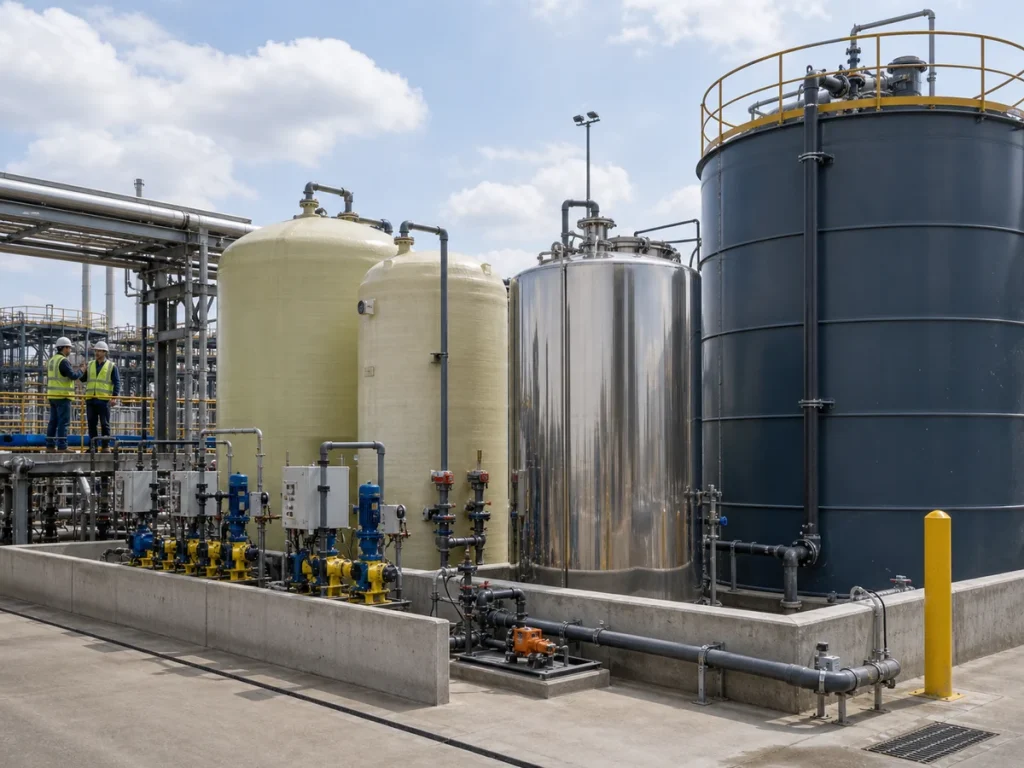
Material selection should compare the installed and operating system, not only the quoted tank shell. A cheaper tank material may require a more expensive coating, more frequent inspection, special foundation tolerances, more careful pipe supports, or earlier replacement. A more expensive material may reduce maintenance, downtime, or corrosion risk in the right service.
Lifecycle review should include procurement cost, fabrication time, transport, installation method, foundation requirements, coating or lining quality control, inspection access, repair method, compatibility with cleaning procedures, expected downtime, and future modification needs. The best material is usually the one that reduces total project and operating risk under the real service conditions.
Material Selection Checklist
- Define normal and upset chemistry, including pH, chlorides, solids, temperature, density, vapor, and cleaning chemicals.
- Check internal corrosion, external corrosion, UV exposure, abrasion, and biological activity.
- Review coating, lining, gasket, sealant, bolt, and nozzle materials as part of the tank system.
- Confirm foundation tolerance, anchor details, and settlement limits that may affect the selected tank system.
- Coordinate nozzle loads, pipe supports, flexible connections, manways, mixers, vents, drains, and instrumentation.
- Compare inspection and repair methods before selecting a material that looks attractive on purchase price alone.
- Ask vendors for service references, compatibility basis, design assumptions, and quality-control documentation.
Common Selection Mistakes
One common mistake is selecting stainless steel because it sounds premium without checking chloride level, temperature, and crevice conditions. Another is selecting carbon steel because it looks economical while underestimating coating quality and maintenance access. FRP and plastic tanks can also be misapplied when pipe loads, temperature, or support conditions are ignored.
A more subtle mistake is choosing the tank material separately from the rest of the project. Material selection affects foundation design, installation sequence, lifting method, nozzle layout, containment design, repair planning, and commissioning checks. EPC teams should therefore treat material selection as an interface decision, not only a procurement comparison.
Conclusion
Carbon steel, stainless steel, FRP, plastic, glass-fused-to-steel, bolted coated steel, and concrete each have valid uses in industrial storage projects. The correct choice depends on stored medium, corrosion risk, mechanical demand, installation method, inspection access, and lifecycle expectations.
A good tank material decision is practical rather than fashionable. It matches real service conditions, supports reliable construction, and gives operators a maintainable asset after commissioning.