
Above-ground storage tank foundation design is one of the earliest civil decisions that can affect the whole project schedule. If the foundation concept is left vague until after tank procurement, the EPC team may discover late conflicts in anchor bolt layout, settlement tolerance, containment drainage, pipe routing, or installation access.
This article continues our earlier guide to industrial storage tank selection. The tank itself may receive most of the procurement attention, but the foundation is where tank loads, soil behavior, construction tolerance, and long-term operation meet. A reliable procurement package should therefore define the foundation interface before the purchase order is released.
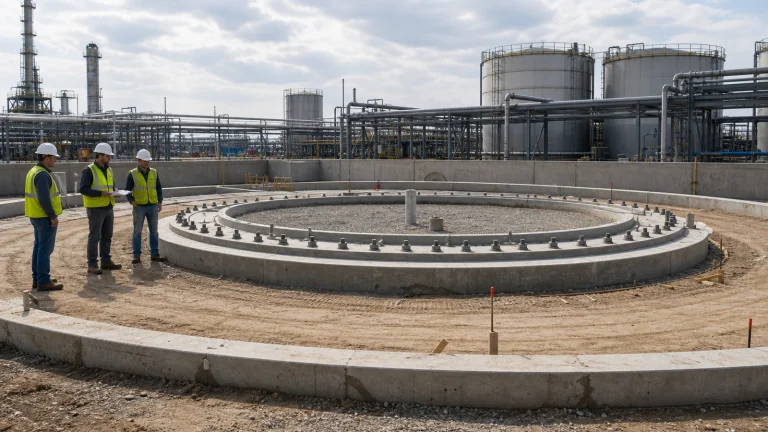
Why Foundation Review Must Start Before Procurement
Tank suppliers, civil engineers, EPC contractors, and owners often work from different assumptions. The supplier may quote a tank based on capacity, diameter, shell height, roof type, material, and basic design loads. The civil team may still be waiting for confirmed tank reactions, anchor quantities, floor details, nozzle orientation, or operating weight. The site team may already be planning earthworks, drainage, and access roads. When these assumptions are not aligned, the foundation becomes a source of rework.
For a large above-ground tank, the procurement stage should not only ask, “What is the tank price?” It should also ask: what exact load data, anchor arrangement, base detail, bottom slope, and tolerance information will the foundation designer receive, and when will those drawings become frozen enough for civil construction?
1. Confirm Geotechnical Data and Design Ground Level
Foundation design begins with soil behavior. A tank filled with water, wastewater, chemicals, sludge, digestate, or process liquid can impose heavy and relatively uniform vertical loads, but the site soil may not respond uniformly. Before procurement, the EPC team should confirm that the geotechnical report reflects the actual tank location, design ground level, groundwater condition, expected fill, and construction sequence.
The review should cover allowable bearing pressure, total settlement, differential settlement, groundwater level, liquefaction risk where relevant, frost depth in cold regions, expansive or collapsible soil conditions, and whether ground improvement is required. If the project is located on reclaimed land, soft clay, loose fill, or an area with high groundwater, a simple foundation assumption can become unsafe or expensive.
Design ground level also matters. A change in finished grade can affect ring beam height, containment volume, drainage slope, pipe penetration elevation, access platform height, and crane setup. These are civil and mechanical interfaces, not isolated foundation details.
2. Match Foundation Type to Tank Size and Service
Common foundation concepts include compacted granular pads, concrete ring walls, reinforced concrete ring beams, slab foundations, pile-supported foundations, and combinations of these systems. The right choice depends on tank diameter, tank weight, stored liquid density, settlement tolerance, soil conditions, seismic and wind requirements, corrosion protection needs, and installation method.
A small shop-fabricated tank may only require a relatively simple slab or support pad if the soil and loads are straightforward. A larger field-erected storage tank often needs a more carefully designed ring foundation or reinforced concrete system. For tanks with sensitive linings, bottom plates, floating covers, mixers, internal columns, or closely connected pipework, settlement control becomes more important.
The foundation must also support inspection and maintenance. Bottom drainage, leak detection, annular plate access, corrosion monitoring, and cleaning access should be discussed before the foundation geometry is finalized.
3. Define Loads in a Usable Format
Tank load information should be more than a single operating weight. Civil designers typically need empty weight, operating weight, hydrotest weight, roof and platform loads, wind loads, seismic loads where applicable, anchor loads, overturning effects, nozzle loads that may transfer into the shell, and any mixer or agitator loads. The load cases should also distinguish normal operation, hydrotest, maintenance, and extreme environmental conditions.
For procurement, the owner and EPC contractor should ask the supplier to provide load data in a format the civil engineer can use directly. If the load table arrives late or is inconsistent with the quoted tank geometry, the foundation package may need revision after site work has already started.
4. Lock Anchor Bolt Layout Before Concrete Placement
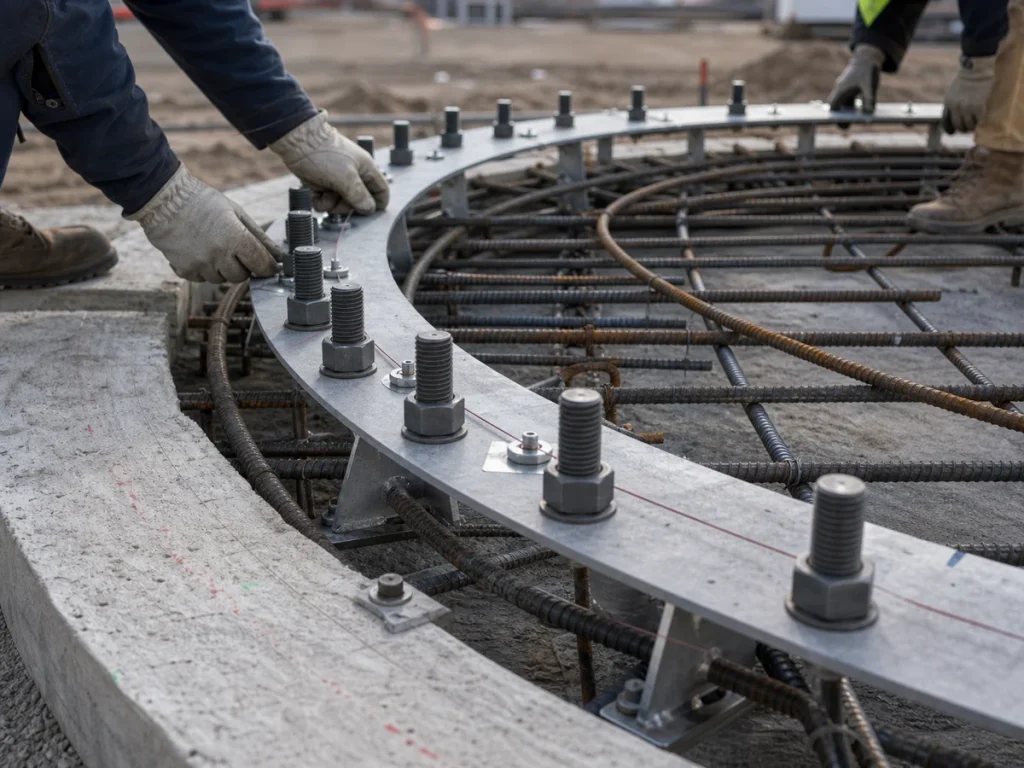
Anchor bolts are a frequent source of field problems because they connect the tank vendor’s steel design to the civil contractor’s concrete work. The EPC team should confirm anchor quantity, diameter, bolt circle diameter, projection, embedment, sleeve or template requirements, leveling plate details, tolerance, grout requirements, and corrosion protection before concrete placement.
Late anchor changes can be costly. If the tank supplier revises the bolt circle or changes the shell base detail after the foundation is poured, field correction may require drilling, epoxy anchoring, local demolition, custom base plates, schedule delay, or engineering concession. Even when a correction is technically possible, it may reduce confidence in installation quality.
Anchor bolt templates should be treated as controlled interface documents. A procurement package should define who supplies the template, who verifies its dimensions, who supervises installation, and how survey records are documented before and after concrete placement.
5. Coordinate Settlement Tolerance With Tank and Piping Design
Settlement is not only a civil issue. Uneven settlement can distort the tank shell, affect bottom slope, stress nozzle connections, damage coating or lining systems, and reduce roof or cover performance. For tanks connected to rigid pipe racks or buried pipe systems, differential movement between the tank foundation and adjacent supports must be reviewed.
The EPC team should agree on acceptable settlement criteria, monitoring points, preloading or hydrotest observation requirements, and corrective actions if settlement exceeds expectations. If the tank will be connected to sensitive process equipment, flexible joints, expansion loops, pipe support spacing, and installation sequence should be considered together with the foundation design.
6. Integrate Secondary Containment and Drainage
A tank foundation rarely stands alone. It often sits inside a containment area, bund, curb, or process drainage system. The foundation layout should therefore be checked against containment volume, stormwater management, spill collection, chemical compatibility, low-point drains, sump locations, vehicle access, and operator routes.
Drainage is especially important in outdoor tank farms and wastewater treatment facilities. Poor drainage around the foundation can lead to standing water, coating damage, corrosion risk, erosion of supporting material, unsafe access, or contaminated runoff. Foundation elevation, slope direction, curb openings, and drainage valves should be part of the same early review.
For storage tank design and operation, this early foundation review should be treated as part of the same engineering decision chain as tank material, capacity, corrosion protection, and maintenance access.
7. Check Construction Sequence and Site Access
Foundation design should be practical to build. The EPC team should confirm excavation limits, formwork access, rebar congestion, concrete pour sequence, curing requirements, survey hold points, embed installation, crane access, tank plate staging, welding or bolting work area, and temporary works. A foundation that looks clean in a drawing can still be difficult to construct if the site is congested or the tank is installed inside an operating facility.
Construction sequence also affects quality. For example, anchor bolts should be protected from movement during concrete placement. Survey checks should occur at the right hold points. Concrete surface flatness and elevation should be confirmed before tank erection begins. If grout or leveling material is required, the method should be known before the tank crew arrives.
8. Align Vendor Drawings With Civil IFC Documents
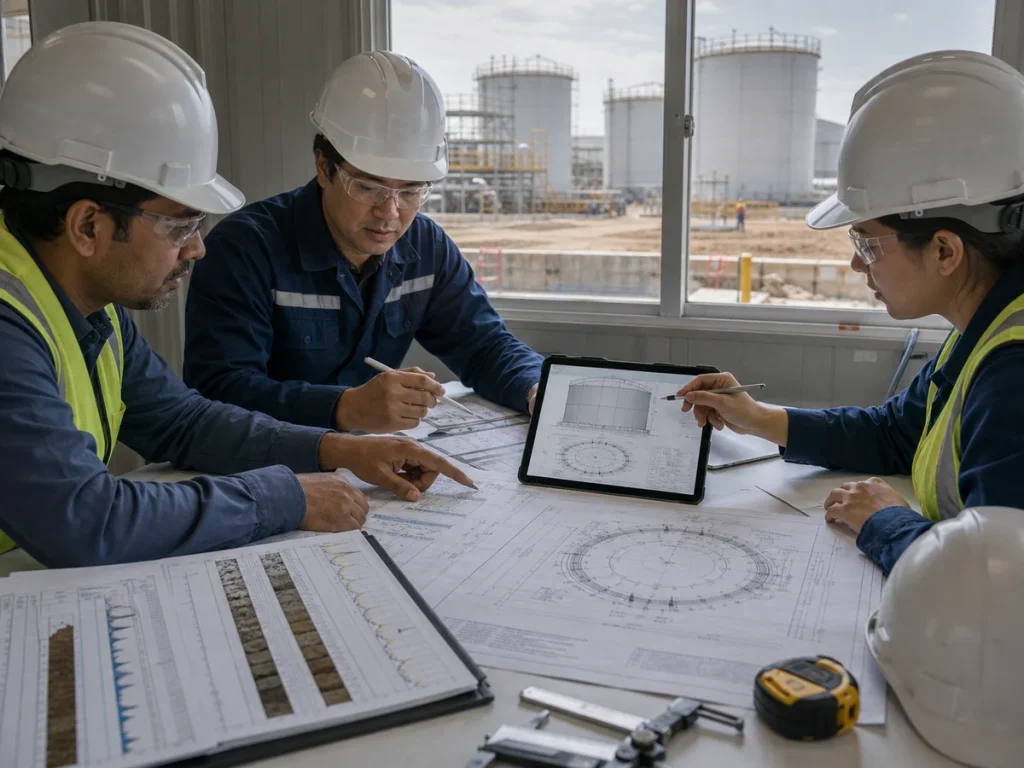
One of the most important procurement-stage controls is document alignment. The tank vendor’s general arrangement drawing, foundation load drawing, anchor bolt plan, nozzle orientation, platform layout, and installation manual should be reviewed against civil IFC drawings, structural calculations, drainage plans, pipe layouts, and electrical grounding details.
The review should answer practical questions: Does the foundation drawing use the same coordinate system as the plant layout? Are nozzle orientations and pipe rack routes compatible? Is there enough room for manway access and lifting equipment? Does the containment wall interfere with shell assembly or inspection access? Are grounding points, embedded plates, and conduit routes shown before concrete work starts?
This kind of coordination is part of EPC execution discipline. It is also where procurement quality, civil design, site planning, and commissioning risk become connected in one practical workflow.
Procurement Checklist for Tank Foundation Interfaces
- Confirmed tank diameter, shell height, roof type, material, and operating liquid density.
- Geotechnical report matched to actual tank location and design ground level.
- Foundation type selected based on soil behavior, tank size, settlement tolerance, and construction method.
- Supplier load data covering empty, operating, hydrotest, wind, seismic, roof, platform, and anchor load cases where relevant.
- Anchor bolt plan with bolt circle, quantity, diameter, projection, embedment, template, and survey tolerance.
- Agreed settlement criteria and pipe flexibility strategy.
- Secondary containment, drainage, sump, and access requirements integrated with foundation elevation.
- Clear responsibility for vendor drawing approval, civil IFC release, survey records, and installation hold points.
Common Mistakes to Avoid
The most common mistake is treating the tank foundation as a civil detail that can be finalized after the tank is purchased. In reality, foundation quality depends on early vendor information, site data, construction tolerance, and mechanical layout. Another common mistake is reviewing only the tank diameter and operating weight while ignoring hydrotest load, anchor loads, settlement tolerance, and containment drainage.
Teams should also avoid assuming that a standard foundation sketch is enough for every site. Soil conditions, groundwater, seismic demand, tank service, installation method, and maintenance access can all change the design. A strong EPC process turns these issues into a pre-procurement checklist instead of a late site problem.
Conclusion
Above-ground storage tank foundation design should be confirmed before procurement reaches the final purchase stage. The EPC team should align geotechnical data, load cases, anchor bolt layout, settlement tolerance, containment drainage, construction sequence, and vendor drawing responsibilities early. This reduces rework, protects installation quality, and helps the tank system perform reliably after commissioning.
A well-designed tank foundation is not only concrete below the tank. It is the physical interface between engineering assumptions, procurement decisions, site execution, and long-term operation.