
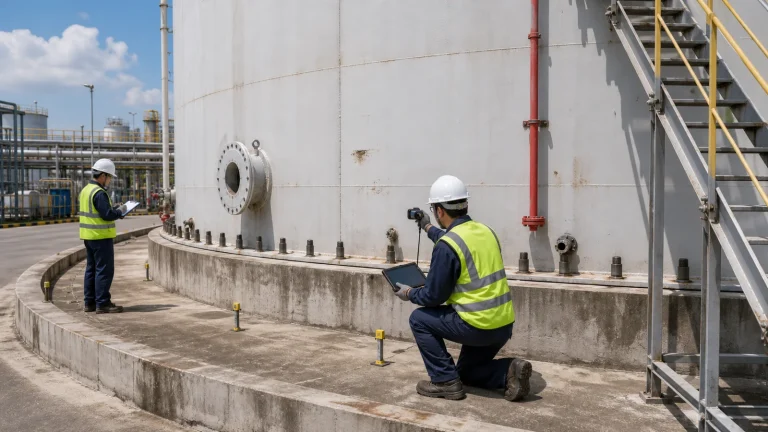
Above-ground storage tank inspection is not only a compliance activity. It is the practical way owners decide whether a tank can continue operating, needs repair, should be taken out of service, or requires a more detailed engineering assessment. A tank may look acceptable from a distance while settlement, hidden corrosion, coating breakdown, nozzle stress, roof damage, or foundation drainage problems are already reducing its remaining life.
For EPC and plant maintenance teams, inspection should connect field observations with measurable data. A useful program combines routine external checks, formal inspections, thickness readings, settlement surveys, coating reviews, roof and nozzle checks, repair history, operating service, and future outage planning. The goal is to find degradation early enough that maintenance can be planned rather than forced by leakage or shutdown.
Why Tank Inspection Needs a Structured Plan
Industrial tanks work under different conditions. Some store clean water at stable temperature. Others store wastewater, chemicals, fuels, process liquids, brine, oils, slurries, or liquids that cycle between hot and cold service. Inspection scope should match the real service. A generic walk-around may miss the actual damage mechanisms in that tank.
Standards such as API 653 and API RP 575 are commonly used references for above-ground storage tank inspection, repair, alteration, and inspection practices in relevant services. Owners should also follow local regulations, insurance requirements, company standards, and service-specific requirements. The important EPC point is that inspection should be planned around credible damage mechanisms, not only calendar dates.
1. Review Service History Before Walking the Tank
The best inspection starts before anyone reaches the tank. The team should review stored product, operating temperature, fill and drawdown cycles, cleaning history, previous inspection reports, repairs, leaks, coating records, foundation settlement surveys, nozzle changes, roof modifications, and any abnormal events such as overfill, vacuum, high wind, flooding, fire exposure, or product contamination.
Service history tells inspectors where to look carefully. A tank with frequent water draw-off may have bottom corrosion risk. A tank with aggressive wastewater may have coating and vapor-zone corrosion risk. A tank with heavy connected piping may show nozzle stress. A tank with past settlement may need survey comparison rather than a one-time visual judgment.
2. Foundation and Settlement Checks
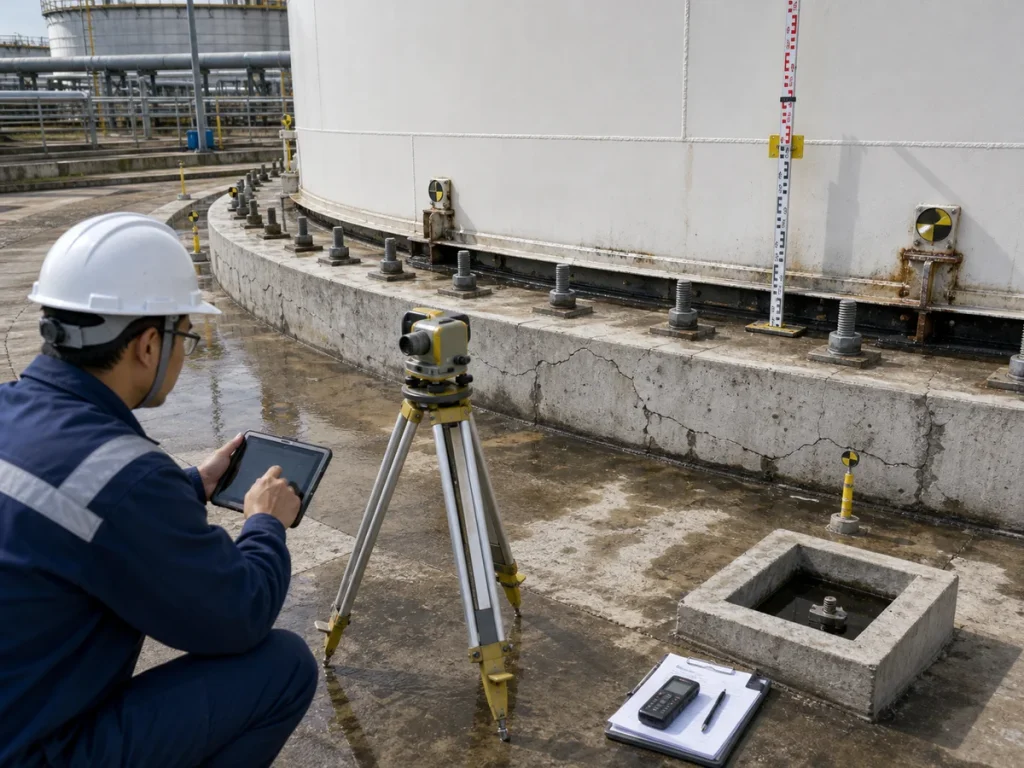
Foundation condition is one of the most important inspection areas because foundation movement can distort the shell, bottom, roof, nozzles, and connected piping. Inspectors should look for ringwall cracking, settlement gaps, erosion, edge settlement, ponding water, vegetation growth, damaged grout, broken anchor bolts, corroded anchor chairs, uneven support, and signs that the tank bottom edge is not properly supported.
Settlement should be measured and trended where required. A single survey can identify current out-of-level condition, but repeated surveys show whether movement is stable or continuing. The original above-ground storage tank foundation design assumptions should be compared with actual field behavior, especially after heavy rain, nearby excavation, seismic events, or changes in tank operating weight.
3. Shell Plate and Weld Condition
Tank shell inspection should check coating condition, corrosion, pitting, dents, buckling, peaking, banding, bulging, weld defects, shell distortion, shell-to-bottom joint condition, manway reinforcement, nozzle reinforcement, and previous repair areas. Shell deformation may be caused by settlement, vacuum, wind, construction damage, thermal movement, or local overstress.
Visual inspection should be supported by measurements when conditions are suspicious. Dent depth, local deformation, shell plumbness, out-of-roundness, weld condition, and shell thickness may need more detailed assessment. A small surface stain may be cosmetic; a corrosion zone near a weld, nozzle, or floor edge may deserve immediate thickness checks.
4. Ultrasonic Thickness Testing and Corrosion Mapping
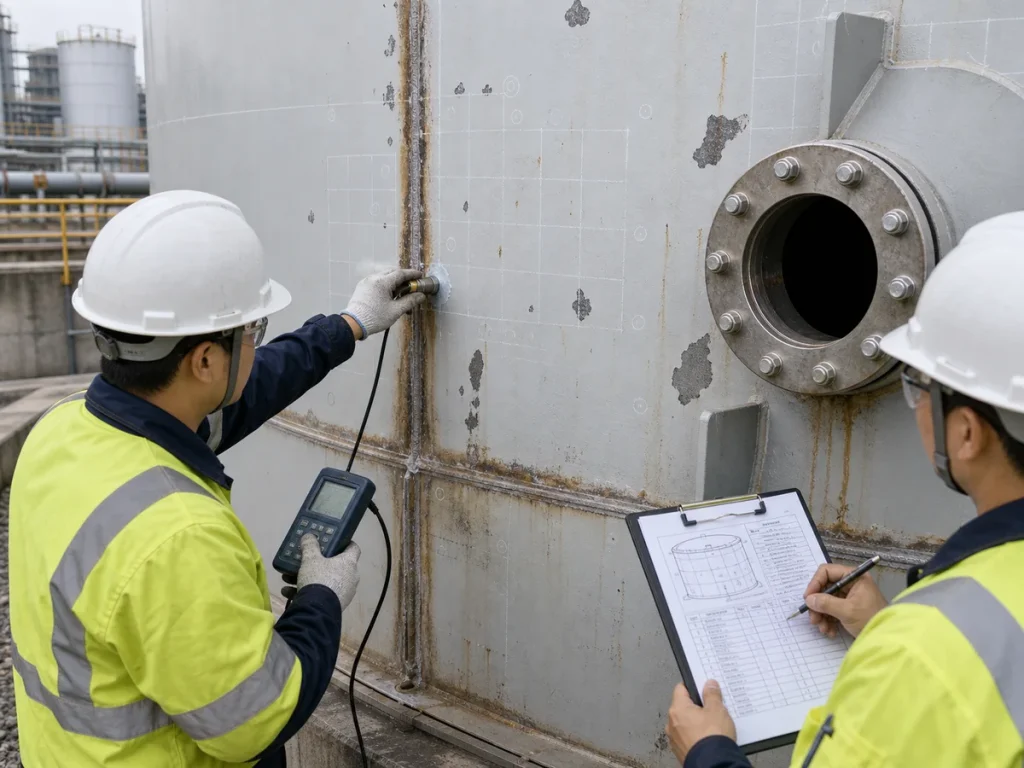
Ultrasonic thickness testing helps identify remaining shell or bottom thickness where corrosion is expected. Readings should be taken in a planned pattern based on service, previous findings, likely corrosion zones, and inspection access. Random readings can miss localized thinning. Corrosion mapping is especially useful around bottom courses, waterline zones, nozzles, roof-to-shell areas, and previously repaired locations.
Thickness data should be compared against original nominal thickness, corrosion allowance, previous inspection records, and required minimum thickness criteria. The value of UT is not only the individual reading; it is the trend. Stable slow corrosion can be managed differently from rapidly changing localized attack.
5. Bottom and Annular Plate Risk
The tank bottom is difficult because much of it cannot be seen externally while the tank is in service. Bottom-side corrosion may be driven by soil conditions, water accumulation, failed cathodic protection, poor drainage, or contaminated foundation materials. Product-side corrosion may come from water bottoms, sludge, corrosive liquid, microbial activity, or damaged internal lining.
Inspection planning should decide when internal inspection, floor scanning, vacuum box testing, magnetic flux leakage, ultrasonic mapping, or other methods are needed. The shell-to-bottom corner and annular plate area deserve special attention because they connect settlement, corrosion, weld condition, and structural load transfer.
6. Internal Coatings and Linings
Internal lining condition can determine whether the tank remains protected or corrosion is already developing underneath. Inspectors should check blistering, peeling, cracking, mechanical damage, holidays, rust staining, edge breakdown, underfilm corrosion, poor repairs, and coating damage near welds, nozzles, floor corners, mixer zones, roof underside, and sludge areas.
Findings should be compared with the original storage tank internal coatings and linings specification, application records, cure records, holiday testing, and repair history. A lining defect may be isolated, or it may indicate service incompatibility, poor surface preparation, excessive temperature, or cleaning chemical damage.
7. Roof, Vents and Drainage
Roof inspection should cover fixed roof plates, roof slope, ponding, corrosion, deformation, vents, emergency vents, gauge hatches, flame arresters, foam chambers, roof drains, floating roof seals, rolling ladders, deck fittings, roof legs, and water accumulation. Roof problems are often neglected because they are harder to access safely.
For floating roof tanks, seal condition and drain function are critical. For fixed roof tanks, pressure-vacuum vents and emergency vents should be inspected for blockage, corrosion, stuck pallets, damaged gaskets, paint, insects, ice risk, or poor access. The inspection plan should align with the tank’s roof design and venting strategy, because each roof type has different failure modes.
8. Nozzles, Manways and Connected Piping
Nozzles and manways are common stress concentration points. Inspectors should check flange leakage, gasket condition, bolt corrosion, reinforcement plate corrosion, telltale holes where present, shell distortion around nozzles, pipe support condition, flexible connection movement, settlement-related strain, and signs that connected piping is pushing or pulling on the tank shell.
Nozzle inspection should not stop at the tank wall. The connected pipe supports, guides, anchors, expansion loops, valves, pumps, and platforms all affect nozzle load. If pipe supports settle or corrode, the tank nozzle may become the unintended support point.
9. External Coating and Corrosion Zones
External coating condition gives early warning. Common problem areas include shell bottom courses, roof edges, ladder brackets, platform clips, insulation terminations, under pipe supports, behind nameplates, around nozzles, beneath leaking vents, and near areas where water or chemicals splash. Coating damage should be ranked by service exposure and corrosion severity, not only by appearance.
Insulated tanks need special attention because corrosion under insulation can progress out of sight. Damaged jacketing, wet insulation, failed seals, missing bands, and open penetrations should be recorded and repaired before corrosion spreads.
10. Containment, Drainage and Housekeeping
Inspection should include the area around the tank. Containment walls, bund floors, drains, normally closed valves, sumps, pipe penetrations, stairways, access roads, and housekeeping affect environmental control and emergency response. A tank shell may be sound while the surrounding containment system is unable to control a release.
Standing water near the tank base can accelerate corrosion and hide foundation issues. Vegetation, debris, chemical residue, oily water, or blocked drains should be treated as maintenance findings, not only housekeeping observations.
11. Repair Prioritization
Inspection findings should be ranked by risk. A failed label or faded paint mark is not the same as active bottom corrosion, continuing settlement, blocked emergency venting, leaking nozzle, severe coating failure, or shell deformation. A good report separates immediate safety or environmental issues from planned maintenance, monitoring items, and long-term capital repairs.
Repair decisions should consider remaining thickness, corrosion rate, service criticality, stored liquid hazard, leakage consequence, repair access, outage timing, and whether temporary mitigation is acceptable. Some findings can wait for the next planned outage. Others require prompt engineering review or taking the tank out of service.
12. Records and Inspection Intervals
Inspection records should be useful for future decisions. They should include photographs, locations, thickness readings, settlement points, corrosion maps, coating condition, repair recommendations, responsible parties, due dates, and comparison with previous findings. A report that says “acceptable” without data has limited value when the next inspection team needs to judge change over time.
Inspection intervals should be based on service, age, corrosion rate, previous condition, regulatory requirements, and risk. Calendar-based inspection alone may be insufficient for tanks with changing service or known damage mechanisms. Conversely, a well-documented low-risk tank can be managed more rationally when data supports the decision.
Above-Ground Storage Tank Inspection Checklist
- Review service history, product changes, repair records, coating records, settlement surveys, and abnormal operating events.
- Inspect foundation, ringwall, anchor bolts, edge support, drainage, erosion, ponding, and settlement trend.
- Check shell plates, welds, coating, dents, buckling, corrosion, pitting, deformation, and previous repairs.
- Use UT thickness testing or corrosion mapping where service history or visual findings justify measurement.
- Plan internal bottom inspection based on age, service, water bottoms, soil-side risk, lining condition, and prior results.
- Inspect internal coatings and linings for blistering, peeling, holidays, rust staining, chemical attack, and mechanical damage.
- Check roof plates, vents, emergency vents, drains, floating roof seals, deck fittings, gauge hatches, and access safety.
- Review nozzles, manways, flange leakage, reinforcement plates, pipe supports, and settlement-related nozzle stress.
- Inspect external coating, insulation, ladders, platforms, clips, brackets, and splash or condensation zones.
- Include containment, drains, sumps, housekeeping, access roads, and surrounding maintenance conditions.
- Rank findings by safety, environmental consequence, structural risk, corrosion rate, and operating criticality.
- Keep inspection records detailed enough for future comparison and repair planning.
Common Mistakes to Avoid
The first mistake is treating inspection as a visual walk-around only. Visual checks are important, but they cannot replace thickness data, settlement surveys, coating records, internal inspection, or engineering review when findings suggest deeper risk. The second mistake is recording defects without assigning priority or responsibility.
Another common mistake is inspecting the tank shell while ignoring the foundation, roof, nozzles, connected piping, and containment area. Storage tanks fail as systems. A weak pipe support, blocked roof vent, failed drain valve, or continuing settlement can be as important as shell corrosion.
Conclusion
Above-ground storage tank inspection and maintenance should turn field condition into planned action. The work is not only finding corrosion. It is understanding settlement, shell condition, bottom risk, roof performance, nozzle stress, coating life, containment readiness, and the history of repairs and operating service.
For EPC and plant maintenance teams, a disciplined inspection program protects safety, environmental performance, uptime, and asset life. The strongest programs combine practical field observations with measurable data, clear records, risk-based priorities, and maintenance plans that are realistic before the next outage arrives.